Stop doing 50% off for Black Friday: a 5-day plan for your client, with the Claude brief and 11 ChatGPT prompts
Everyone posts the same red SALE banner. Hide the product in everyday objects for 5 days and reveal the offer on Friday. Claude brief and 11 prompts included.
Watch the reel on InstagramComment #黑五 to get this guide
On Black Friday every brand posts the same red banner, so nobody stops. We made a full Black Friday week for a fictional Taipei handmade shoe brand, BUGUANG: for four days the same shoe hides in everyday objects (a sheet of paper, a turntable, a toaster, shoe boxes), and only on day five does the offer appear. Claude wrote the plan and the prompts, ChatGPT made the 11 images. Every image below is the real result.
01The game: hide the product in everyday objects
Everyone's Black Friday looks the same: red background, huge type, 50% OFF. The design isn't bad. Every brand just posts it, so you scroll past without knowing whose it was. This plan does the opposite: for four days it says nothing about a sale, it only shows the same shoe a little more each day, and on day five it pastes the answer on a wall.
- Day 1 · Mon 11.23, paper: the shape of a shoe under a sheet of paper just pasted on a wall.
- Day 2 · Tue 11.24, analog: what spins on the old turntable is not a record, it's the shoe.
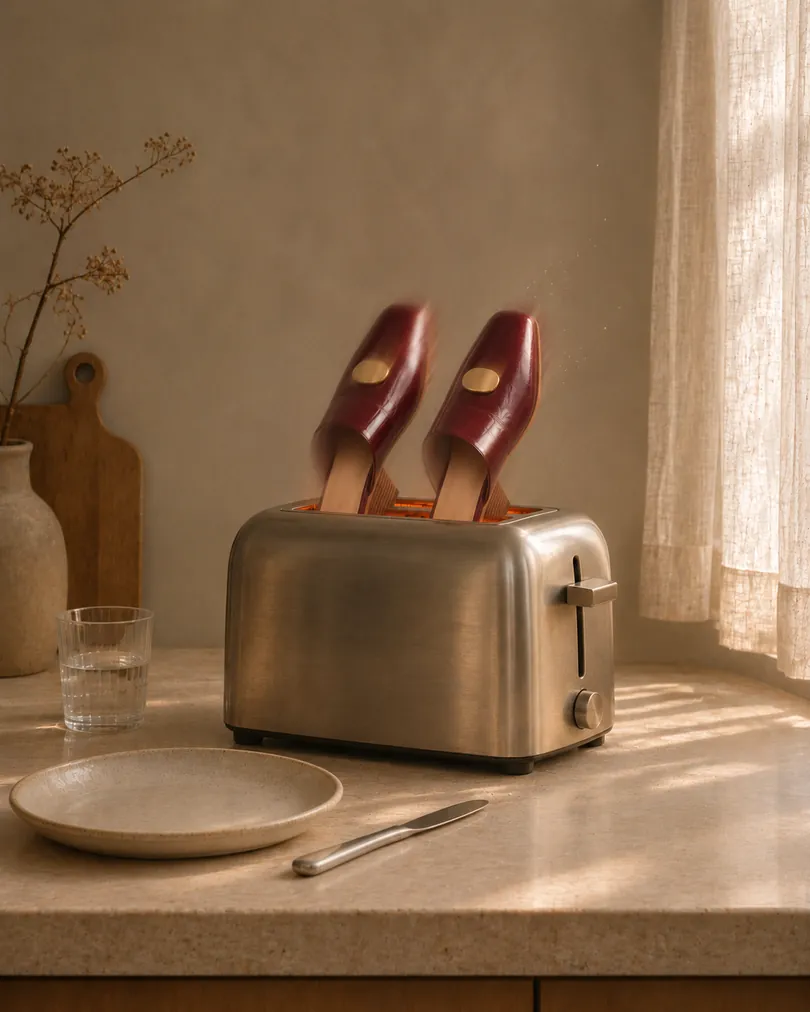
- Day 3 · Wed 11.25, into the home: what pops out of the breakfast toaster is not toast.
- Day 4 · Thu 11.26, someone shows up, nobody speaks: a figure from behind loads shoe boxes into a car.
- Day 5 · Fri 11.27, Black Friday: the same wall, the poster goes up, and only now it says "20% off everything, today only".
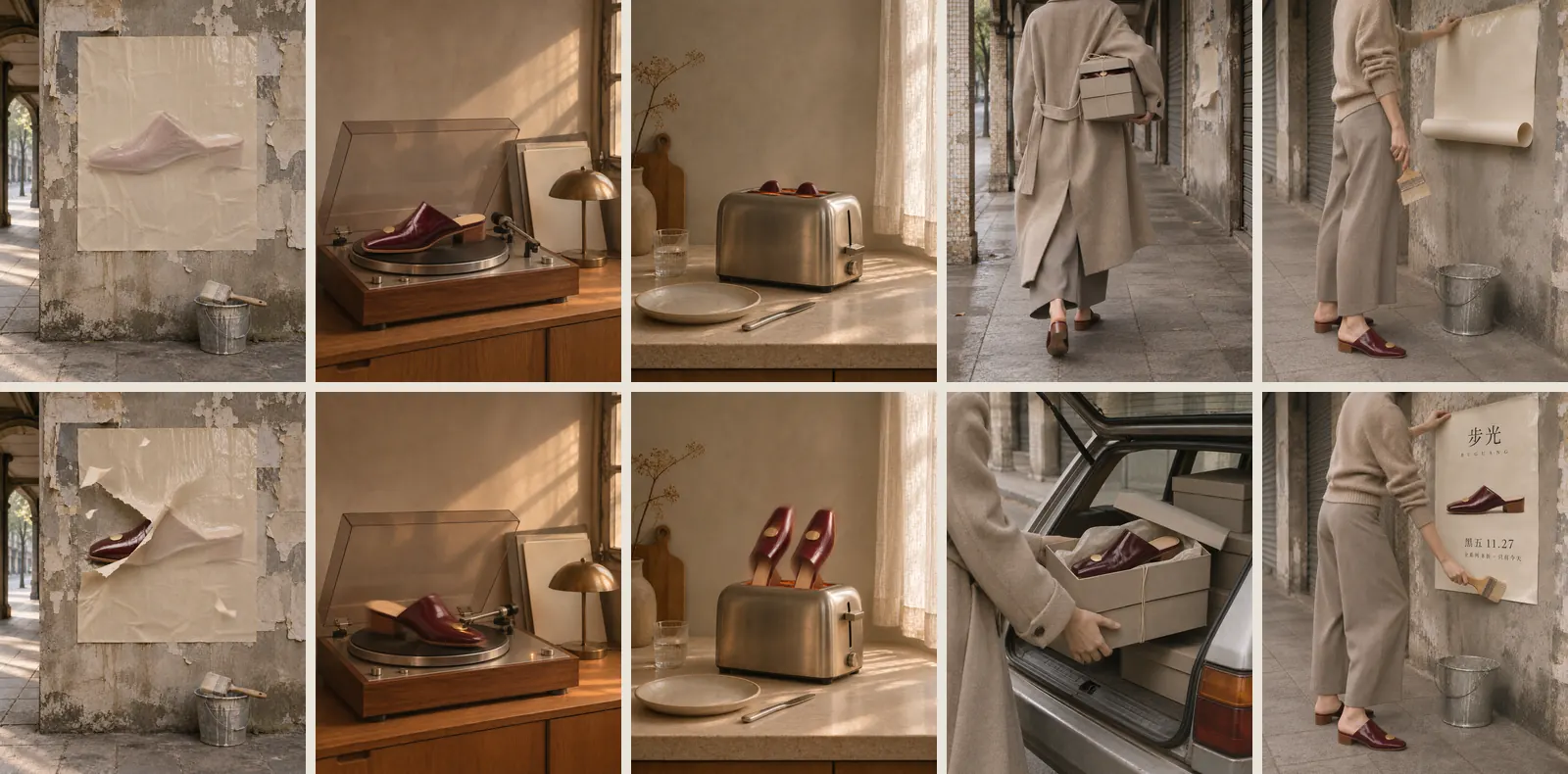
The client, BUGUANG (步光), is a fictional handmade shoe brand from Taipei; the shoe and the people in the photos are AI-generated. You get three things here: the client brief we gave Claude, the 5-day structure Claude wrote, and the 11 ChatGPT image prompts, as written and as templates. Black Friday 2026 is Friday 27 November and the plan starts on Monday 23 November, so there is still time.
02Step 1: give Claude the client brief
Claude wrote the plan and every image prompt. We gave a brand-new Claude with no other context the brief below, and it came back with a full plan: a one-line strategy, a 5-day overview, two frames a day, 11 English image prompts and an Instagram line for each day.
Make a "5-day Black Friday plan" for my client.

Client: [brand name], [where it is, what it sells, how big it is].
The hero product this time: [product name], [colour, material, the one detail people recognise].
Black Friday is [day month year] (a Friday). The plan starts on Monday [date], one image a day.

The problem: on Black Friday every brand posts the same red banner and the same "50% OFF", so nobody stops to look.
I want a full week of images that makes people stop every day and ask: "What are they actually selling?" The offer is only revealed on the last day.

Core idea: hide the product inside everyday objects.

Follow this arc for the week:
- Day 1: start with "paper" (the street, print)
- Day 2: go "analog" (old things that make a sound)
- Day 3: move "into the home" (everyday things at home start to feel off)
- Day 4: the day before, "someone shows up, but nobody speaks" (people carry the product down the street, load it into a car)
- Day 5: Black Friday, "someone finally says it", and only then reveal the offer

For each day, give me:
1. The idea of the day (one sentence)
2. Two frames: frame 1 → frame 2 has to change, like the next second of the same scene (a machine starts, something appears), so the two read like a short clip
3. One English image prompt per frame for ChatGPT (complete, ready to paste)
4. One line of Instagram caption for that day

Before that, give me a "product photo" prompt: this photo is generated first and attached to every later image, so the product is the same every day.

Image spec: vertical 4:5 photos; [style, e.g. quiet, high-end magazine editorial]; overall [palette, e.g. greige], no SALE red; no brands or logos except "[brand name]"; as little text on the images as possible; when people appear, never show faces (backs, hands, parts of the body are fine).
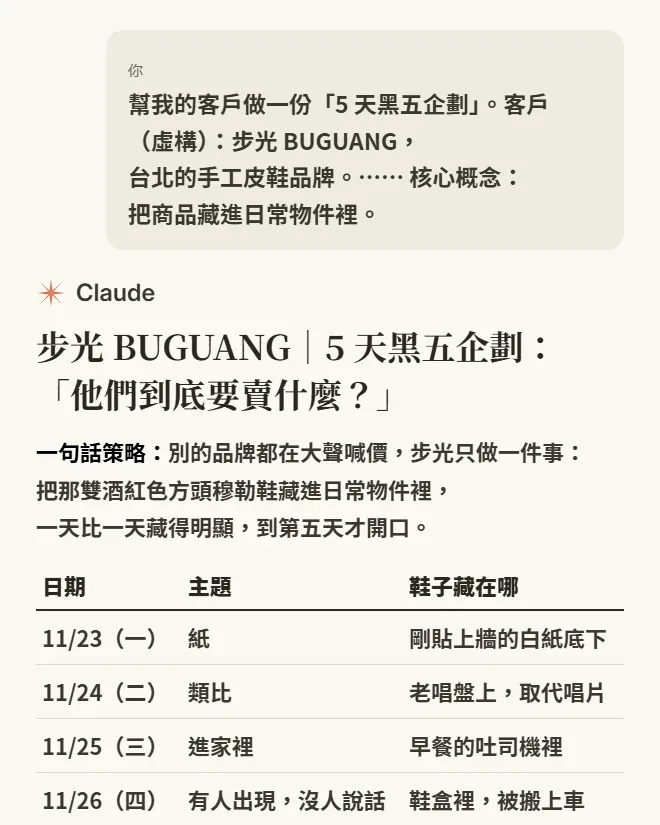
- One-line strategy: while everyone shouts prices, BUGUANG does one thing, hides the shoe in everyday objects, a little less hidden each day, and only speaks on day five.
- A hidden thread: the poster wall from Day 1 is in the background on Day 4, and the answer goes up on the same wall on Day 5. People who follow all week see one story.
- Two extra columns in the table: "any people?" (none for three days, a back and hands on Day 4, shoulders down on Day 5) and "text on the image" (brand name and offer on the last image only).
- Claude — Writes the plan and the prompts
03Step 2: make one product photo in ChatGPT first
The biggest risk in the whole plan is a product that looks different every day. So the first image is not Day 1: it is a clean product photo that every later image uses as its reference. Describe the product so well that a stranger could make it: shape, colour (and what colour it is NOT), material, and the one detail people recognise, with its size and position.
Generate an image. Studio product photograph, vertical 4:5. [A pair of / One] [product] on a seamless [background colour, e.g. warm greige paper] backdrop. The [product] design, which must stay exactly the same in every later image: [shape], made of [colour + material + finish; say what it is NOT, e.g. deep oxblood wine, not bright red]; [the signature detail: what it is, size, exact position]; [base, sole, cap or other parts]. Composition: [one view in clean side profile, one turned to a three-quarter front view so the signature detail is clearly readable]; slightly below the middle of the frame with generous empty space around. Lighting: large soft window light from the left with a gentle falloff, one long soft highlight along the [surface], a soft contact shadow underneath. Shot on a medium-format camera, 100mm lens, f/8, true-to-life color, crisp detail on [materials]. Quiet, high-end editorial mood. No text, no logos, no labels, no props, no people.
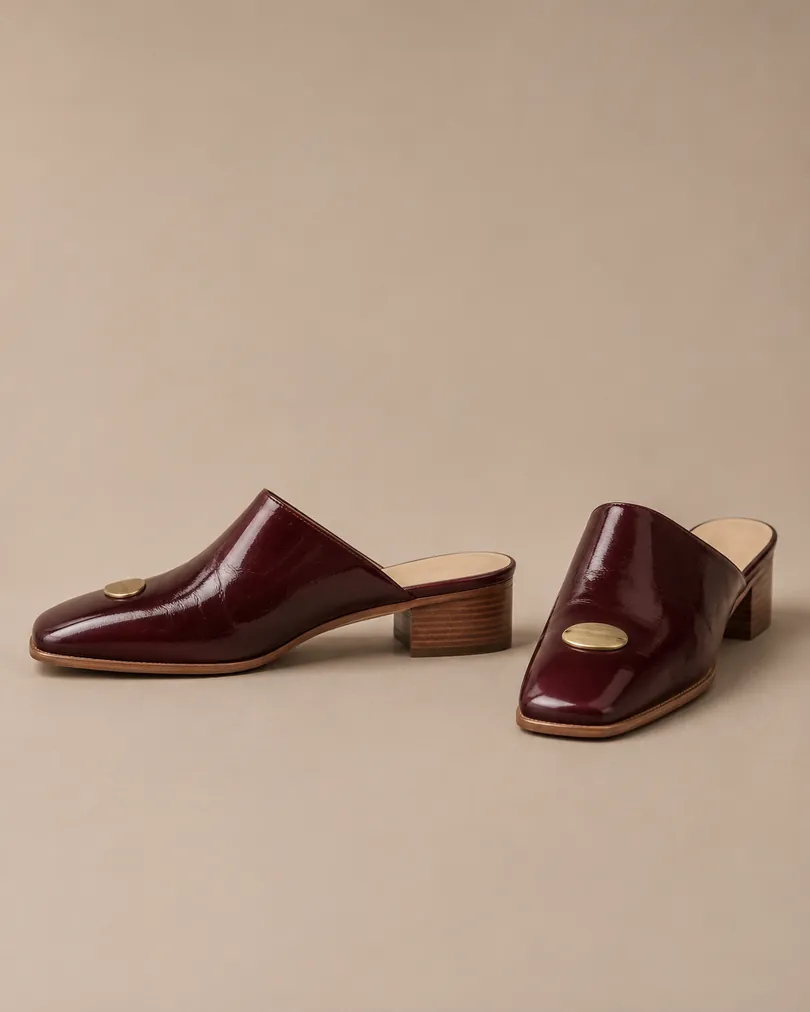
Generate an image. Studio product photograph, vertical 4:5. A pair of handmade women's mules on a seamless warm greige paper backdrop, the color of oatmeal and warm stone. The shoe design, which must stay exactly the same in every later image: a backless slip-on mule with a softly squared toe (square with gently rounded corners) and a clean, fairly high-cut vamp, made of wine-burgundy (deep oxblood wine, not bright red) high-gloss polished calfskin with a mirror-like shine and subtle natural creasing; a small horizontal oval plate of brushed brass, about 3 cm wide, sitting flat and centered on the vamp just above the toe, with a fine horizontal brushed grain and a softly beveled edge, no engraving; a low stacked-leather block heel about 3 cm tall; a natural tan leather sole with a thin visible welt edge; a pale beige leather insole, completely plain. Composition: the left shoe stands in clean side profile, the right shoe is turned to a three-quarter front view so the toe shape and the brass oval are clearly readable; both sit slightly below the middle of the frame with generous empty space around them. Lighting: large soft window light from the left with a gentle falloff, one long soft highlight running along the glossy leather, a soft contact shadow under the shoes. Shot on a medium-format camera, 100mm lens, f/8, true-to-life color, crisp detail on the leather grain, the stitching and the brushed brass. Quiet, high-end fashion editorial mood. No text, no logos, no labels, no props, no people.
04Step 3: two images a day, B is "the next second" of A
Make two images a day: frame A is a quiet scene, frame B is the same scene one second later (the wind tears the paper, the turntable spins, the toaster pops). Together they play like a short clip, or work as a carousel.
- Make all 11 in one ChatGPT chat: the product photo first, then Day 1 A, Day 1 B, Day 2 A… one message at a time, in order.
- Because it is all one chat, we didn't re-upload files: each message starts with a line telling ChatGPT which earlier image is "image 1" (the product photo) and "image 2" (the one just before).
- In a new chat, upload the product photo (and the previous frame A) as attachments and paste the prompts as they are.
- Frame A prompt = opening (which product) + Scene + Style. Frame B prompt = opening (the next second) + Change (only what changes) + the same Style.
Generate an image. (Image 1 = the product photo you generated first in this chat.) Attached image 1 is the product reference. The [product] in this image must be exactly that [product]: [one line: shape, colour, material, signature detail]. Match its color, shine, shape, proportions and details exactly; do not redesign it.

Scene: [time and place]. [the everyday object and how the product hides in it]. [what else is around]. Camera: [angle, lens]; [where the object sits in the frame].

Style: vertical 4:5 photograph, quiet high-end magazine editorial, shot on medium-format film with soft natural light and fine grain. Muted [palette, e.g. greige] palette: [4–5 neutral tones]; the [product colour] of the [product] is the only saturated color in the frame and there is no bright red anywhere. No logos, no brand names, no readable signs or text anywhere in the image. No people.
Generate an image. (Image 1 = the product photo you generated first in this chat. Image 2 = the image you generated just before this message.) Attached image 1 is the product reference; attached image 2 is the previous frame. Create the very next second of image 2: keep the same place, objects, light and color grade, and change only what is described below. The [product] must stay exactly the [product] from image 1: [the same one line as frame A].

Change: [the one thing that moves, opens or appears in the next second]. Same camera position and framing. Everything else is unchanged: [list what was in frame A].

[the same Style paragraph as frame A]
05Day 1 to Day 3: nobody there yet
Here is each day Claude wrote for BUGUANG: the idea, the Instagram line, and the two frames as written (only Scene and Change; the opening and Style come from the templates above). For your product, ask Claude to rewrite them from your brief, or use these as a reference and edit them yourself.
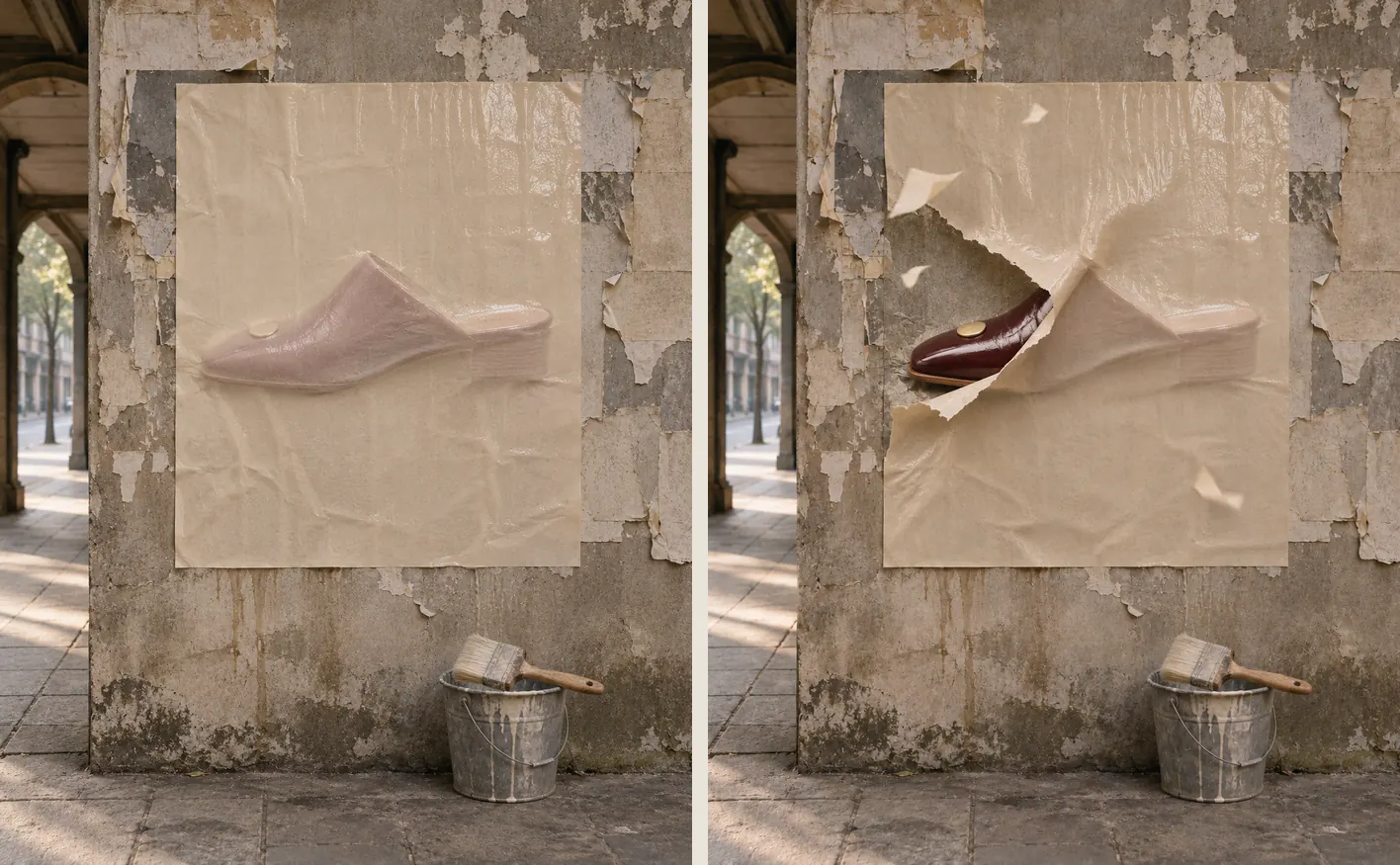
Day 1 idea: you see the shape before you see the thing. Instagram line: "A blank sheet of paper on the wall. Something seems to be under it."
A: Scene: 7 a.m. on a quiet Taipei street. A weathered concrete wall under an old arcade walkway, covered in layers of torn, sun-faded posters in grey and beige, none with readable text. In the center of the wall, one fresh sheet of plain cream paper, about 60 x 80 cm, has just been wheat-pasted and is still slightly damp and glossy with paste. Behind the paper, pressed flat against the wall, is the shoe in side profile at life size: the wet paper has molded tightly over it like an embossed relief, so you can read the squared toe, the low heel and the small oval bump on the vamp. Where the paper is thinnest, a faint wine tone shows through. No part of the shoe is directly visible yet. A wide paste brush rests across the rim of a small metal bucket on the sidewalk below. Camera: straight-on, eye level, 50mm lens; the paper sits in the upper middle of the frame and the cracked concrete sidewalk fills the bottom fifth.

B: Change: a gust of wind has torn the damp paper diagonally from the toe end. The torn flap curls back and reveals the glossy wine-burgundy toe and the brushed-brass oval plate catching the morning light, while the heel half of the shoe stays hidden under the paper. Three or four small scraps of cream paper float in mid-air with slight motion blur. Same camera position and framing. Everything else is unchanged: the same wall, the same old faded posters, the same bucket and brush on the sidewalk.
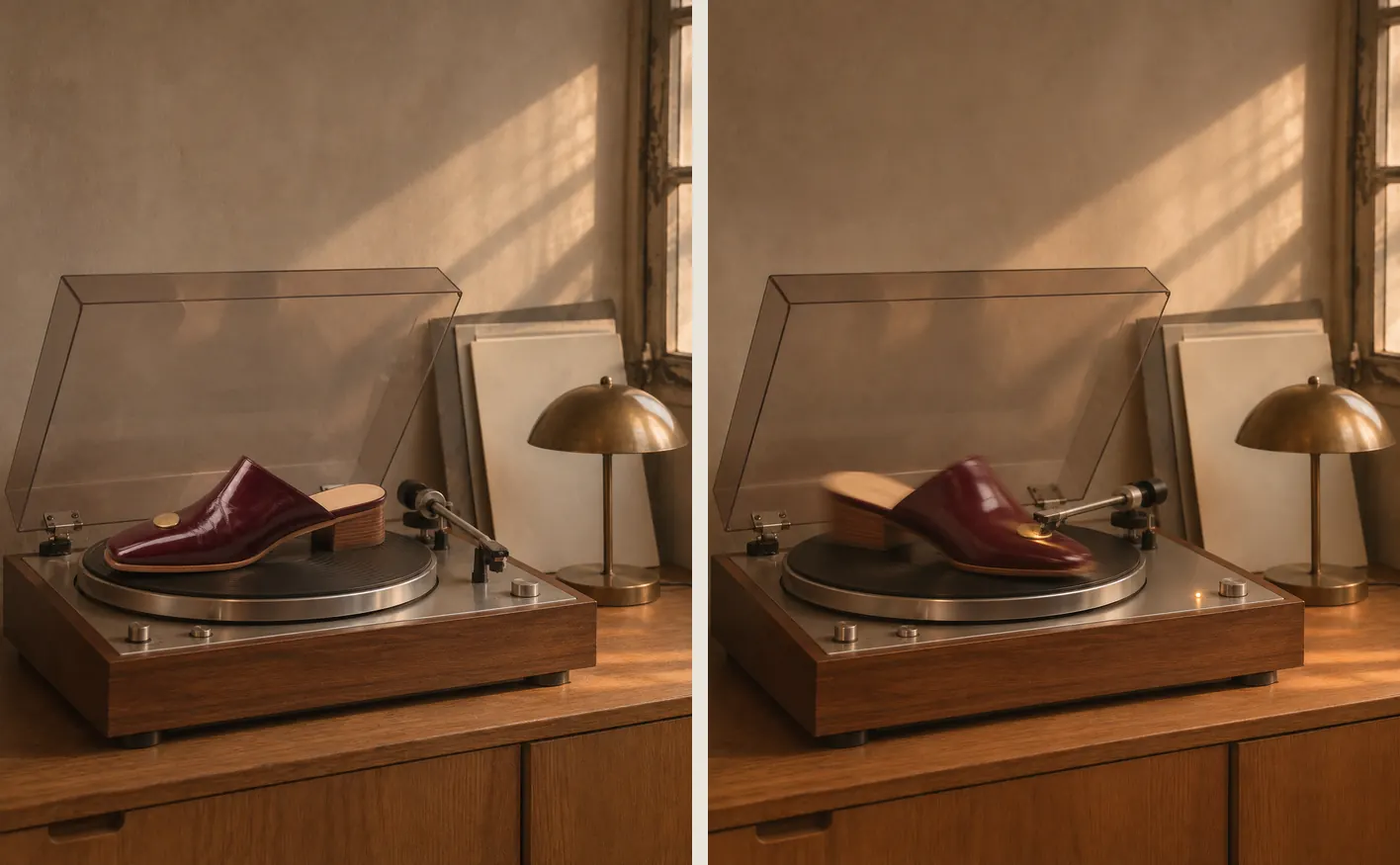
Day 2 idea: where the needle drops is the brass plate. Instagram line: "Some things you only hear once they start spinning."
A: Scene: late afternoon in the living room of an old Taipei apartment, slightly dim and calm. A vintage 1970s turntable in walnut wood and brushed aluminium, with no brand marks, sits on a low oak sideboard against a warm grey limewashed wall; its clear dust cover is lifted open. Instead of a vinyl record, a single shoe stands upright on the still platter, centered, the toe pointing to the left and the brass oval facing the camera. The tonearm rests in its cradle, touching nothing. Leaning against the wall beside the turntable: three record sleeves in plain grey and cream with no printing, and a small brass table lamp, switched off. Warm low sunlight from a window on the right lays one long soft stripe across the wall. Camera: slightly high three-quarter angle, 50mm lens; the turntable fills the lower half of the frame, with quiet empty wall above.

B: Change: the turntable is now on. The platter is spinning and the shoe turns with it, with subtle rotational motion blur along its edges, while the brushed-brass oval throws one short streak of reflected light. The tonearm has swung over and the stylus is lowered, resting delicately on the brass oval plate as if it were playing it. A tiny warm amber power light now glows on the turntable's base. Same camera position and framing. Everything else is unchanged: the same sideboard, record sleeves, lamp and stripe of sunlight on the wall.
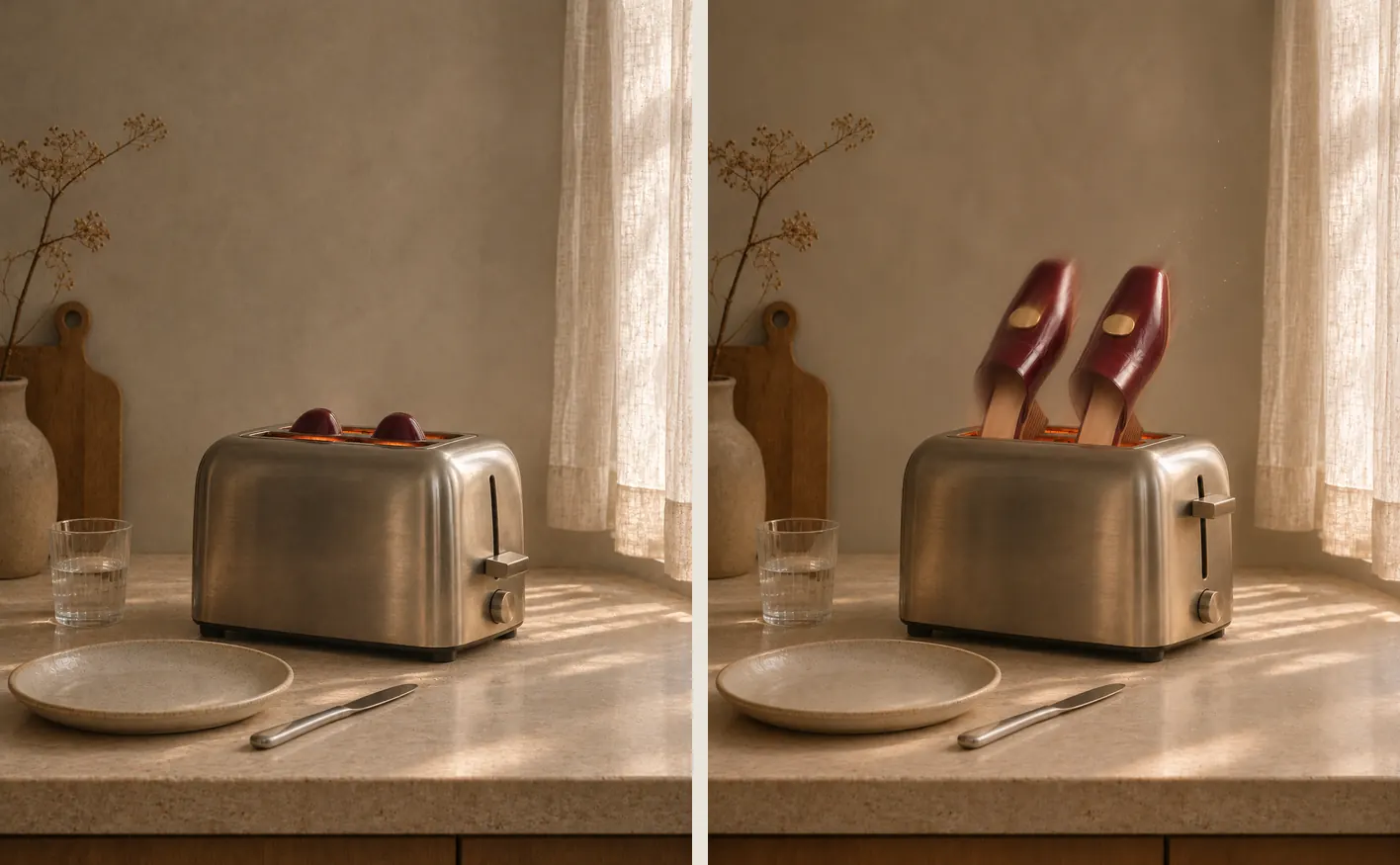
Day 3 idea: the most ordinary breakfast, except what's in the toaster isn't toast. Instagram line: "Something about breakfast feels off today."
A: Scene: 7 a.m. in a calm, minimal home kitchen. A pale travertine countertop, a warm grey plaster wall, soft morning light coming through a sheer linen curtain from the right. In the middle of the counter sits a retro brushed-stainless-steel two-slot toaster with no brand marks. Its lever is pressed down and a faint warm glow comes from inside the slots. Peeking just above the rim of each slot is a thin sliver of glossy wine-burgundy leather: the toe tips of the pair of shoes, standing toes up inside the slots, almost unnoticeable. Beside the toaster: an empty plate in oatmeal stoneware glaze, a butter knife and a small glass of water. It looks like an ordinary breakfast, except for what is in the toaster. Camera: eye level with the counter, 65mm lens; the toaster sits in the lower middle of the frame with calm wall space above.

B: Change: the toaster has just popped. The lever has snapped up and both shoes have jumped up out of the two slots, toes up and heels still inside, caught mid-bounce a little above their resting height with a hint of motion blur. Their glossy leather catches the window light and both brass oval plates face the camera. A few specks of dust drift in the light. Same camera position and framing. The empty plate, butter knife and glass of water are unchanged, and so is everything else.
06Day 4 to Day 5: someone shows up, and finally says it
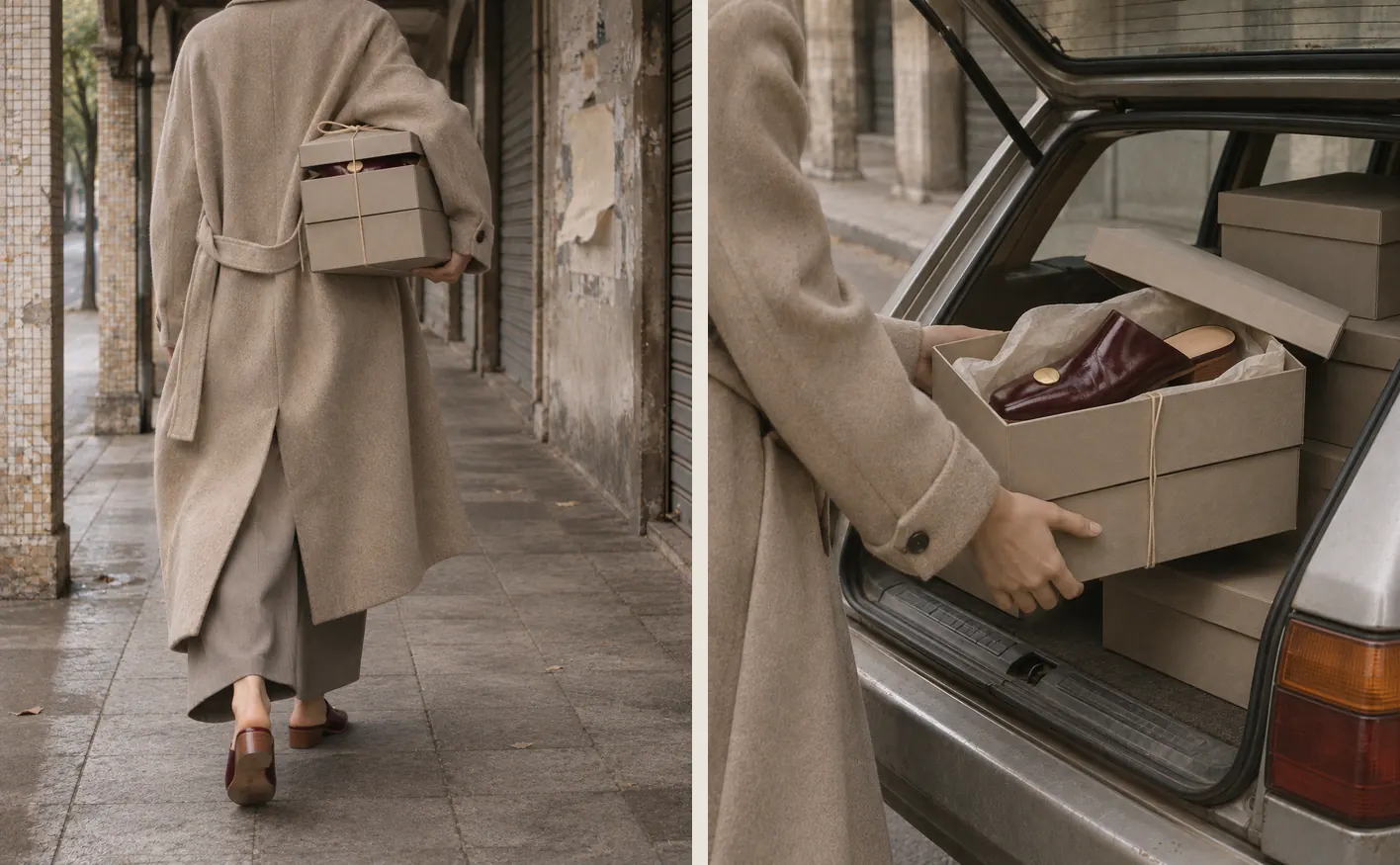
Day 4 idea: the first person appears, says nothing, and just loads box after box into a car. Instagram line: "Nobody says a word. Everyone's just carrying."
A: Scene: early morning on a quiet Taipei side street under a soft overcast sky. An old arcade walkway with tiled pillars runs along the left of the frame; on the wall in the background is a weathered poster wall with one torn cream sheet on it. A woman, seen only from behind and framed from the back of her neck down to her calves (her head stays out of frame), walks away from the camera along the arcade. She wears a long oatmeal wool coat and wide putty-grey trousers. Against her right hip, held with one arm, she carries a stack of three plain greige cardboard shoe boxes tied together with natural cotton string. The lid of the top box sits slightly askew, and through the gap shows a thin sliver of glossy wine-burgundy leather and a small glint of brass. Nobody else on the street, shop shutters closed, no readable signs. Camera: about three meters behind her, eye level, 50mm lens.

B: Change: she has reached the curb beside a small, old silver-grey hatchback with no badges and no visible license plate, its rear hatch lifted open. The camera has moved closer and now frames her from the waist down to the trunk floor: only her hands, coat sleeves and the side of her coat are visible as she slides the stack of boxes into the trunk. The top box has tipped and its lid has slid off, revealing one shoe nested in plain cream tissue paper, its brass oval catching the flat morning light. Inside the trunk, more identical greige boxes are already stacked. Camera: beside the car, slightly low angle, 50mm lens.
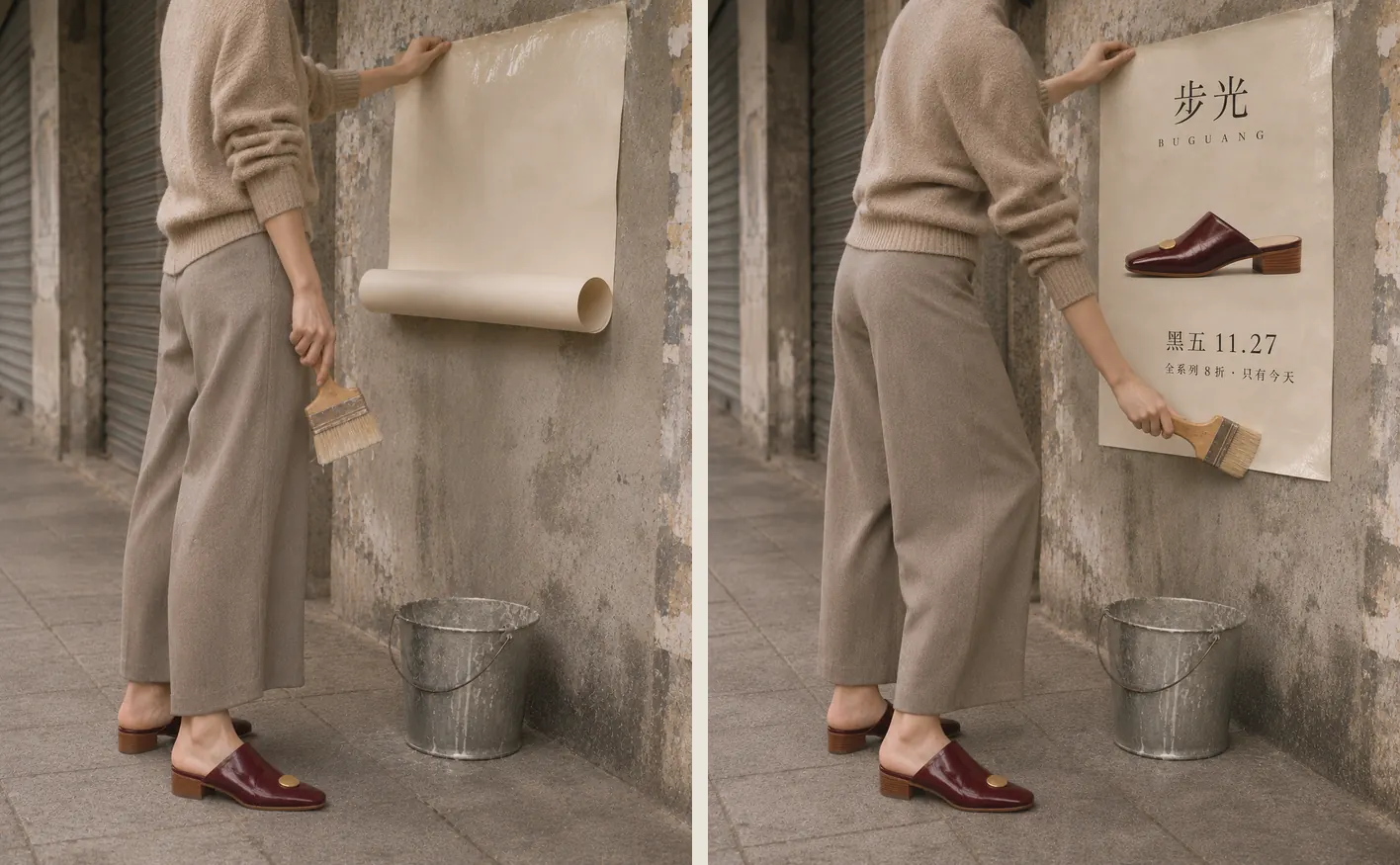
Day 5 idea: back to the same wall, the shoes on her feet, and she pastes up the answer herself. Instagram line: "OK, we're saying it: BUGUANG Black Friday, today only."
A: Scene: the weathered poster wall under an old Taipei arcade walkway, 8 a.m., soft daylight. The old torn posters have been scraped back, leaving a clean patch of grey concrete. A woman stands at the wall, seen from her left side and slightly behind, framed from her shoulders down to the ground (her head stays out of frame). She wears an oatmeal knit sweater and wide cropped putty-grey trousers that end at the ankle, and on her bare feet the pair of wine-burgundy mules from image 1, clearly visible on the concrete sidewalk with one brass oval catching the light. With one hand she holds a large rolled poster against the wall: only its top edge is pasted, the rest is still rolled up, and the little that is unrolled is plain cream with nothing printed on it yet. In her other hand she holds a wide wet paste brush. A small metal bucket sits by her feet. Camera: eye level, 50mm lens; the wall fills the upper two-thirds of the frame and her mules sit in the lower third.

B: Change: the poster is now fully unrolled and smoothed flat on the wall, and she presses its last lower corner down with the brush. Same camera position and framing; her mules stay clearly visible on the sidewalk below. The poster is clean cream paper with, in its center, a photograph of a single shoe in side profile, exactly matching image 1, on a plain greige background, plus minimal black typography in a refined, airy layout with lots of empty space. The poster contains exactly this text and nothing else:
- at the top, large: 步光
- directly below it, small and widely letter-spaced: BUGUANG
- near the bottom, medium: 黑五 11.27
- under that, small: 全系列 8 折 · 只有今天
07Step 4: posting order and captions
- Mon 11.23: A blank sheet of paper on the wall. Something seems to be under it.
- Tue 11.24: Some things you only hear once they start spinning.
- Wed 11.25: Something about breakfast feels off today.
- Thu 11.26: Nobody says a word. Everyone's just carrying.
- Fri 11.27: OK, we're saying it: BUGUANG Black Friday, today only.
Post each day's two images as a carousel (A first, B second), or drop A and B into a video tool and join them into a 3 to 5 second Reel that plays like a short clip.
08When the shoe drifts or the text comes out wrong
Later in the chat the product can slowly drift: the colour gets too red, the square toe turns round, the brass plate disappears. Reply with one line in the same chat and generate again.
Match the shoe in image 1 exactly: wine-burgundy, squared toe, brushed-brass oval on the vamp, 3 cm block heel.
Match the [product] in image 1 exactly: [colour], [shape], [signature detail], [one more detail that keeps drifting].
If the Chinese text on the poster comes out crooked or misspelled, delete the text lines from the Day 5 B prompt, use the line below instead, and set the type later in a design app.
leave the poster area below the photo blank
- ChatGPT — Made all 11 images
09Good to know
- BUGUANG is a fictional brand and this shoe doesn't exist; "20% off everything, today only" is a demo offer.
- All 11 photos are AI images from ChatGPT, and the people in them are AI-generated too, with faces deliberately out of frame. For a real client, switch to real product photos at the end, or at least have the client confirm the AI product matches the real one.
- Check the AI tool's terms of use for generated images, and consider labelling them as AI-generated when you post.
- Confirm the offer with the client: the discount, dates and products on the poster are a public promise.
- The arc was inspired by another designer's reel; we only borrowed the game. Your product, objects, images and captions should be your own: don't copy other people's work.