One scene, 10 art styles: 10 style prompts for animations Claude builds in code (pixel, chalk, neon, 3D…)
Paste one scene prompt for the hero and motion, then swap one style prompt at a time, and Claude writes an HTML animation that plays. All 10 prompts in full.
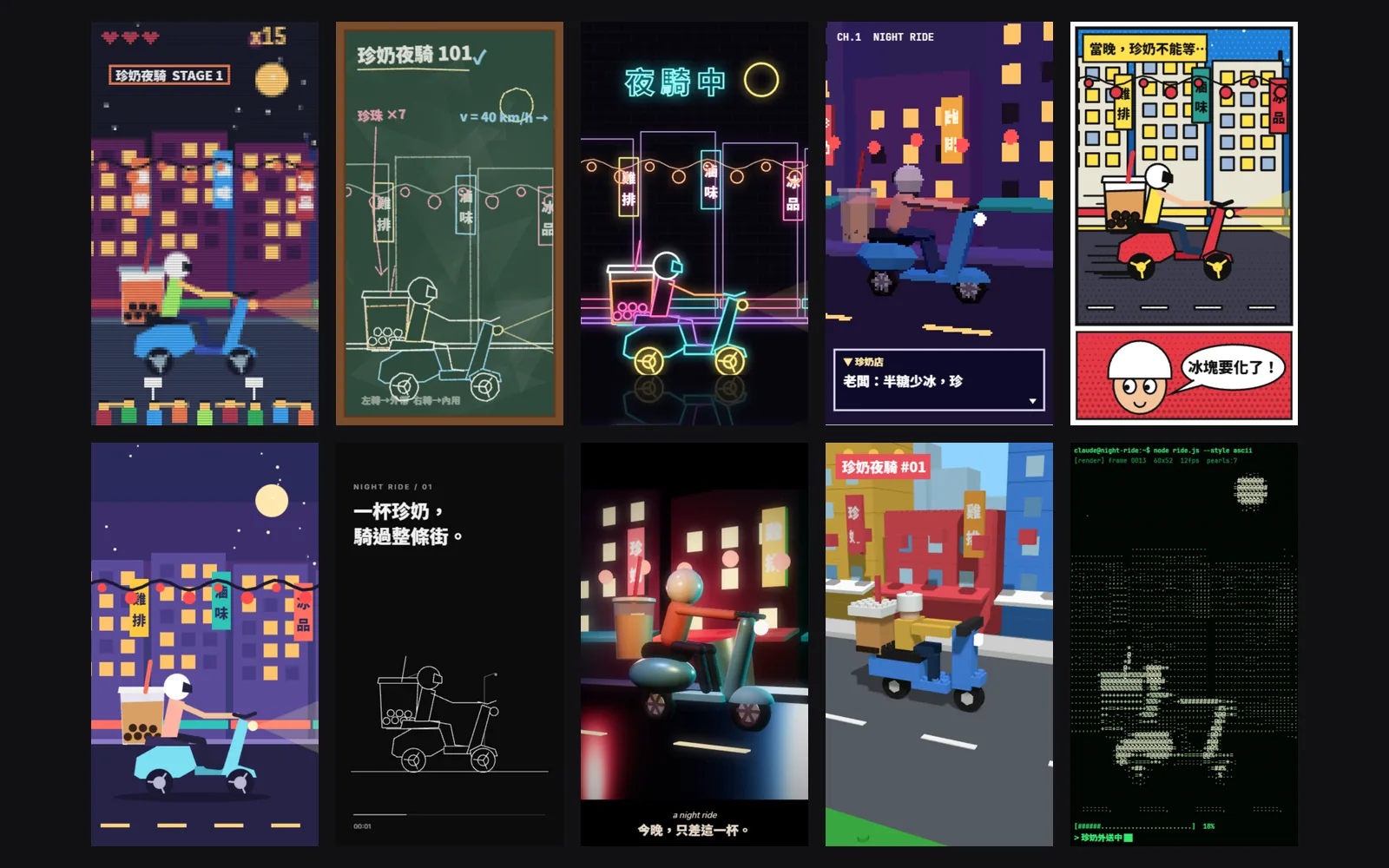
Can one scene become 10 completely different animations? Yes, with no drawing skills and no video model. We wrote one "scene prompt" for the hero and the motion, then added one "style prompt" at a time, and Claude wrote an HTML file that plays. Every image below is a screenshot of an HTML animation Claude wrote: a scooter carrying a giant bubble tea through a Taiwan night market. All 10 prompts are here in full.
01How it works: 1 scene prompt + 1 style prompt
The trick is splitting the prompt in two. The scene part says what to draw: the hero, the background, the motion. The style part only says how to draw it: lines, colours, texture. Keep the scene, swap the style, and the hero and motion stay the same across all 10 looks.
- Open Claude (claude.ai) and start a new chat.
- Paste the scene prompt below and replace the [ ] parts with your topic.
- In the same message, add one style prompt (pick 1 of 10).
- Claude writes an HTML file. Save it as .html and open it in a browser to watch it play.
- For the next style, start a new chat and paste the scene prompt plus another style prompt.
- Claude — a normal chat is enough
02Scene prompt: always paste this first
Make me a single-file HTML vertical animation (360x640, 9:16, loops on its own).
Scene: [place], [hero] [action] towards the [direction], [the key prop on the hero],
[details of how the hero looks]. The background is two layers of [street / landscape] scrolling left: [far layer] in the distance, [near layer, you can spell out the shop-sign words] up close, and [decoration that scrolls along] at the top.
Motion: [the hero's looping motion], every 2.4 seconds [a small event, e.g. a little jump], [how the prop reacts to it].
Build time as a seek(t) function (the same t always draws the same frame) so I can record it as a video.
Here is our filled-in version, ready to try:
Make me a single-file HTML vertical animation (360x640, 9:16, loops on its own).
Scene: a Taiwan night-market street. A scooter rides to the right with a giant bubble tea strapped to the rear rack (you can see the pearls and the straw);
the rider wears a helmet, both hands on the handlebars. The background is two layers of street scrolling left: building silhouettes in the distance, shopfronts up close (lit windows, awnings,
vertical signs reading 珍奶 (bubble tea), 雞排 (fried chicken), 滷味 (braised snacks), 冰品 (shaved ice), 豆花 (tofu pudding)), and a string of red lanterns scrolling along at the top.
Motion: the wheels turn and the body bobs slightly. Every 2.4 seconds it goes over a speed bump and hops; when it hops, the pearls in the cup bounce too, and the headlight throws a beam.
Build time as a seek(t) function (the same t always draws the same frame) so I can record it as a video.
03Style prompts 1–5: pixel, chalk, neon, low-poly, comic
Add each one after the scene prompt. The [ ] parts are the words on our screen; swap in words for your topic and paste the rest as is.
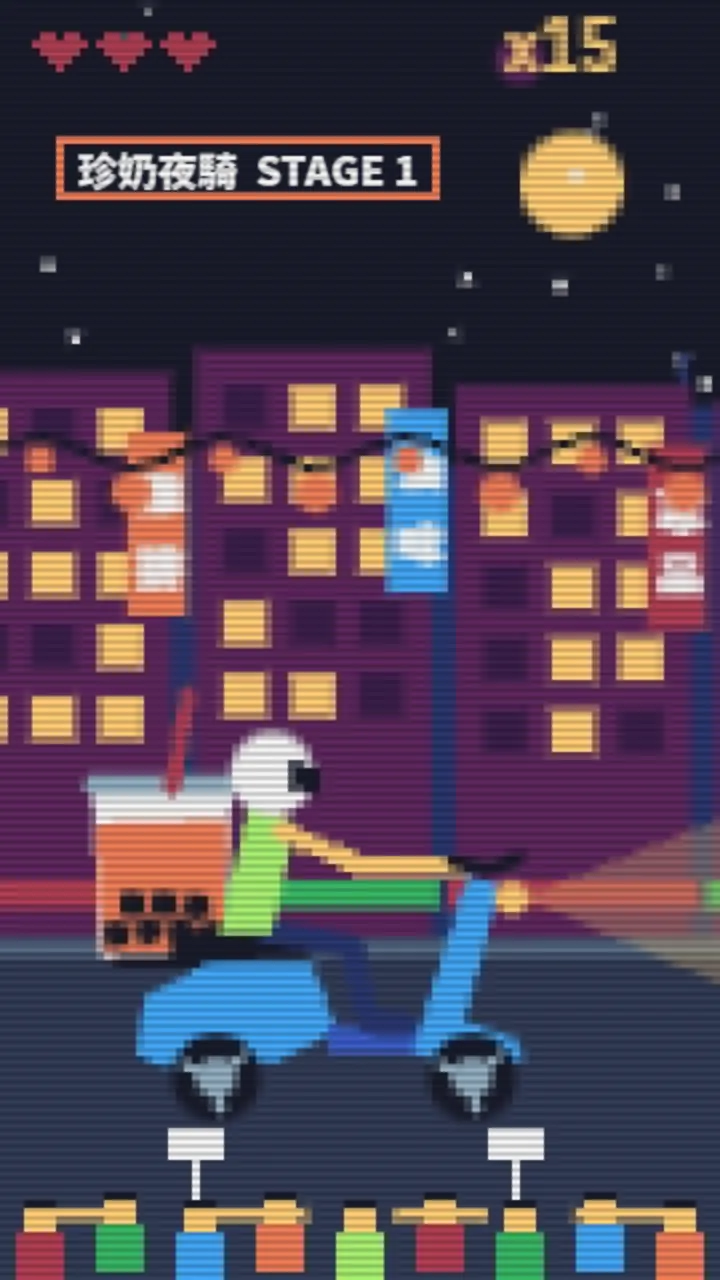
Style: 16-bit arcade game. Draw the whole frame at 1/4 resolution, then scale it up with nearest-neighbour so the pixels have hard edges. Use a 16-colour palette only,
and drop the motion to 12 fps. Add a game HUD: three pixel hearts top left, a [pearl] counter top right (x12, counting up),
a flashing "[NIGHT RIDE] STAGE 1" banner at the top, a row of pixel spectators jumping and holding signs at the bottom, and a CRT scanline layer on top.
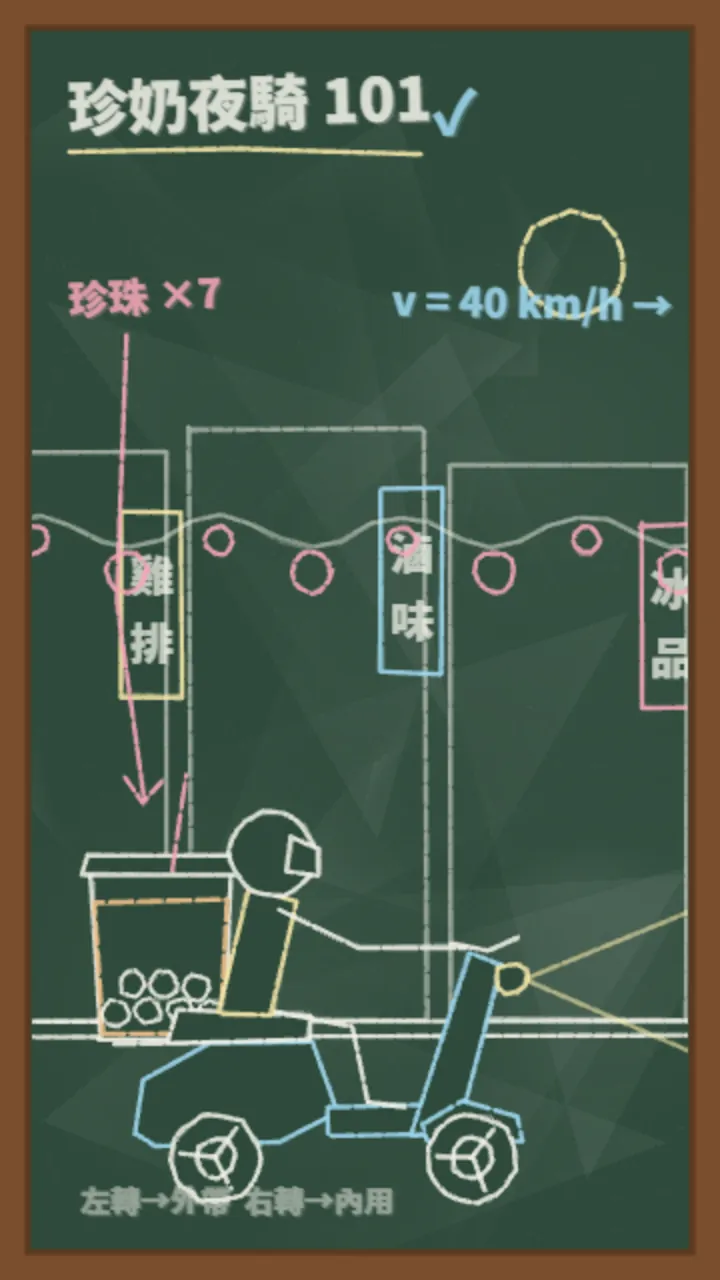
Style: a chalk diagram on a classroom blackboard. Dark green board with eraser smudges and a wooden frame. Lines only, no fills.
Draw every line twice with a chalk texture (one thick, one thin, broken, shaky), and make the lines wobble 8 times a second (line boil).
Coloured chalk for the hero props (blue body, pink [bubble tea], yellow headlight), white chalk for everything else.
Handwritten title "[Night Ride 101]" top left with an underline and a tick, an arrow labelled "[pearls ×7]" pointing at the [cup], "v = 40 km/h →" on the right, and "Jump!" when it jumps.
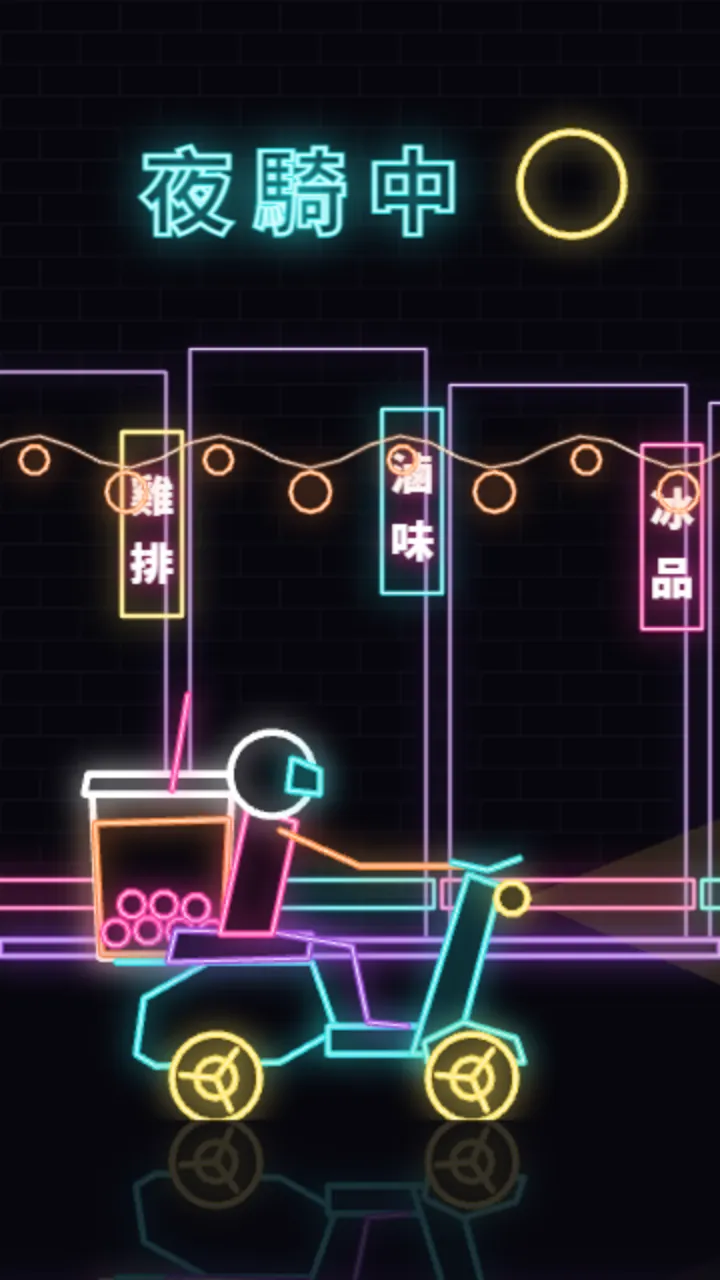
Style: neon tubes. Black brick-wall background. Every object becomes a glowing line: a coloured halo outside and a white-hot core.
Colours: hot pink, cyan, yellow, purple, orange. One sign flickers off now and then. The ground is wet and the whole street reflects in it (about 30% opacity).
Big "[RIDING]" title at the top in hollow cyan neon letters.
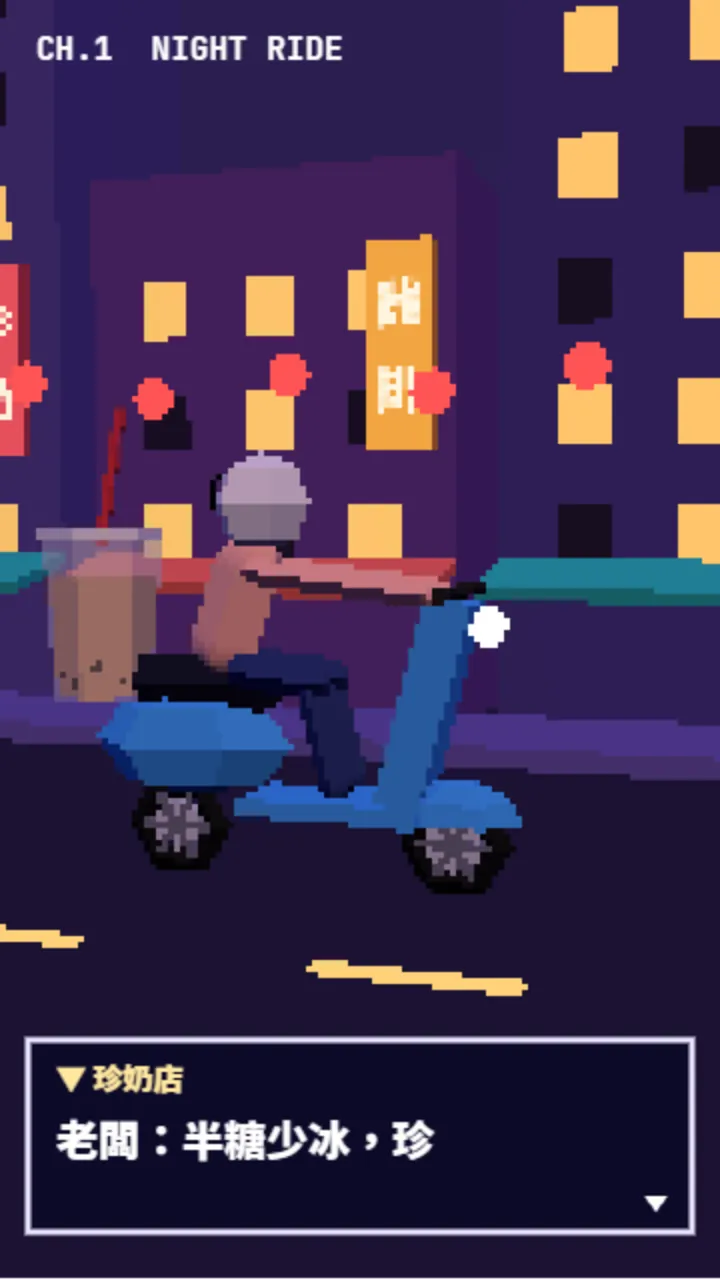
Style: retro-console low-poly 3D, using three.js. Every model uses very few faces (6-sided cylinders), flat shading.
Render at 120x213, then scale up with hard edges, and snap the camera to a coarse grid (that old-console jitter). Purple fog.
Add an RPG dialogue box at the bottom that types out "[Shop owner: half sugar, less ice, your bubble tea is ready!]", and "[CH.1 NIGHT RIDE]" top left.
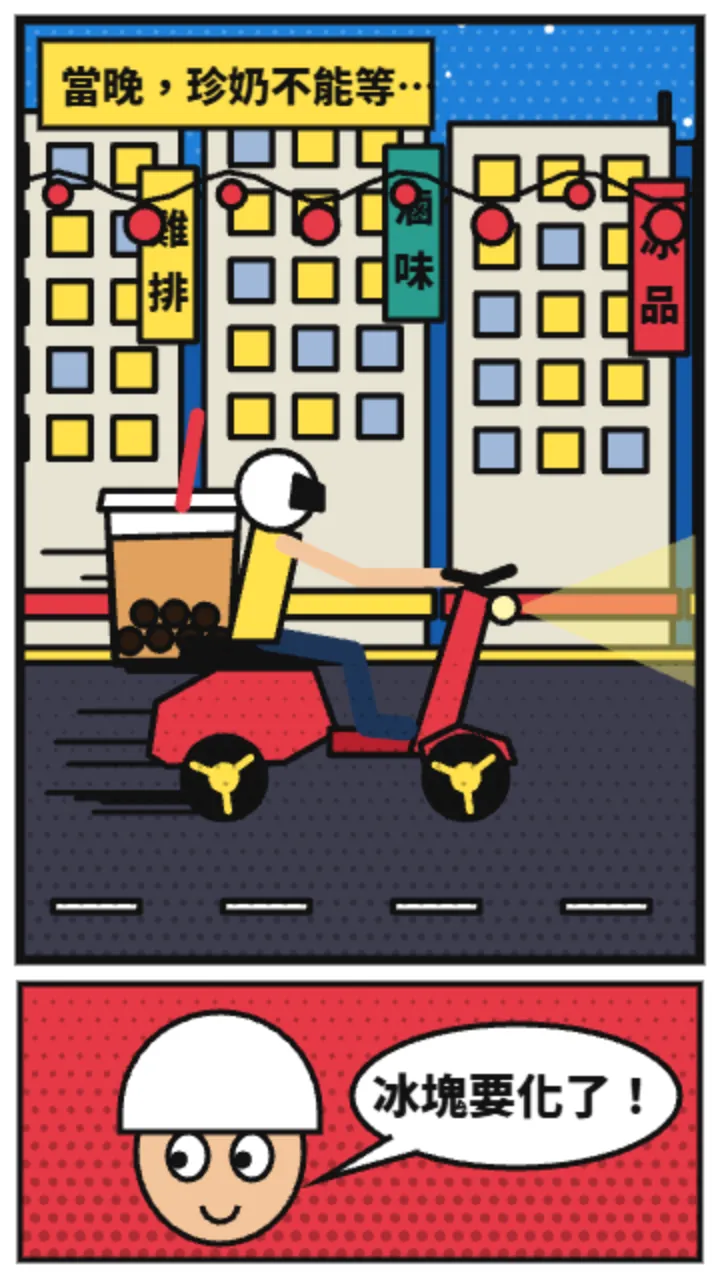
Style: American comic book. Thick black outlines on everything, flat primary colours, Ben-Day dots over the sky and the ground,
animated "on twos" (12 fps). Speed lines behind the scooter, and a yellow burst "[BEEP BEEP!]" pops up on every jump.
Two panels: the top panel is the main shot, with a yellow caption box top left "[That night, the bubble tea couldn't wait…]";
the bottom panel is a close-up of the rider, eyes darting left and right, with a speech bubble "[The ice is melting!]".
04Style prompts 6–10: flat, white line, cinematic 3D, bricks, ASCII
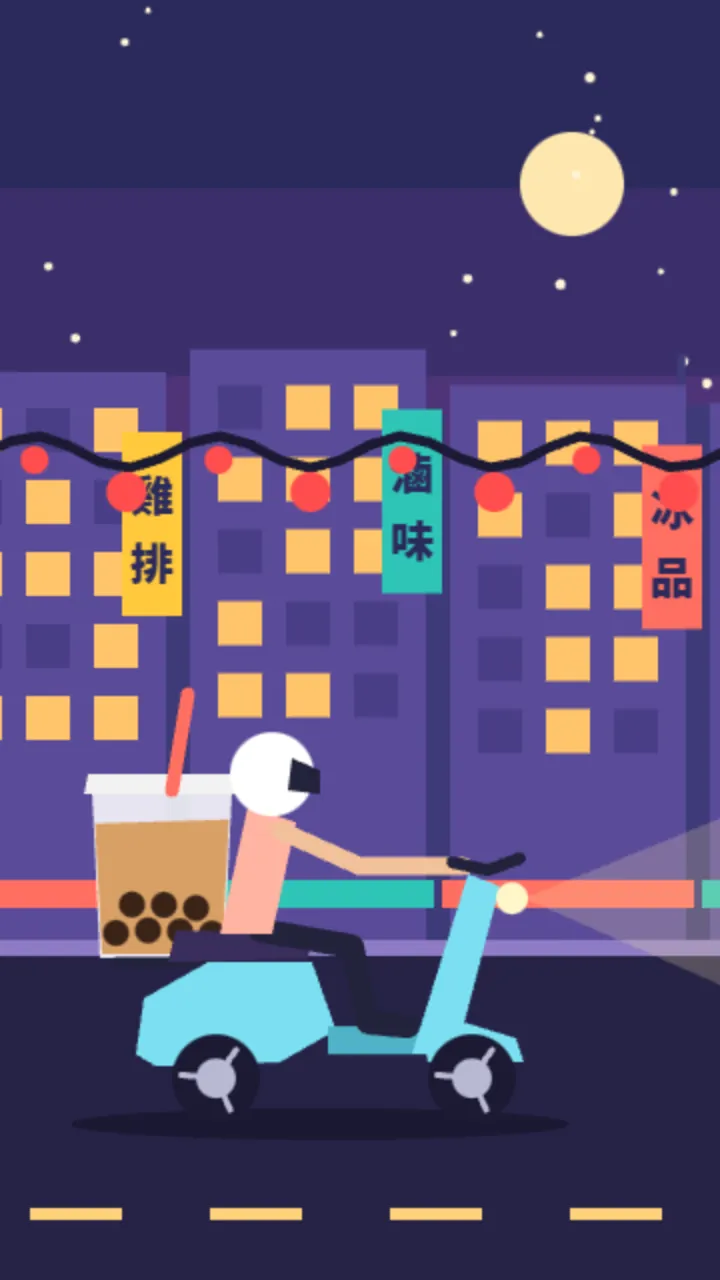
Style: flat vector illustration. No outlines, no gradients (the sky is 5 colour bands), 2-3 tones per object,
a purple night palette with coral, mint and butter-yellow accents, and a long semi-transparent shadow under the scooter. Clean and cute, like a brand illustration.
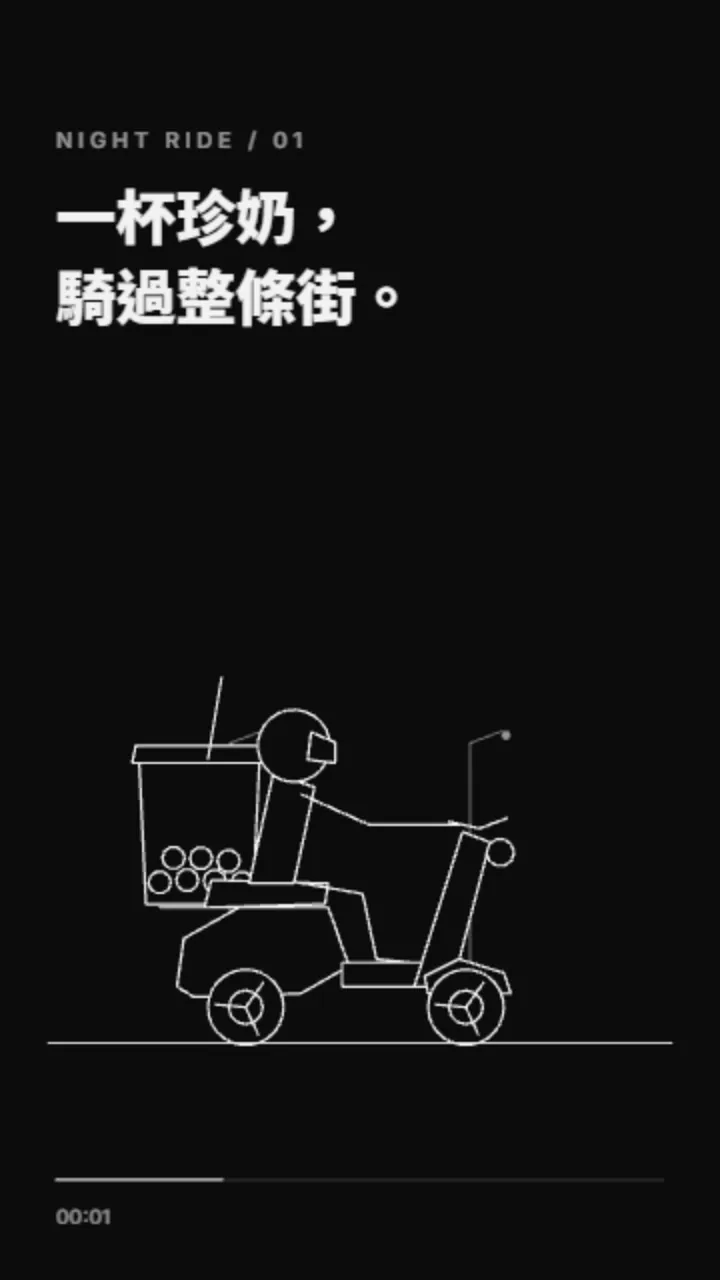
Style: minimal white line. Near-black background, one thin white line weight only (1.4px). Keep only the rider, the scooter and the [bubble tea];
remove the rest of the background except a horizon line and a few streetlights drifting past. Lots of empty space.
Small "[N I G H T   R I D E / 01]" top left, two bold lines below it "[One bubble tea, across the whole street.]", and a thin progress line with a timecode at the bottom.
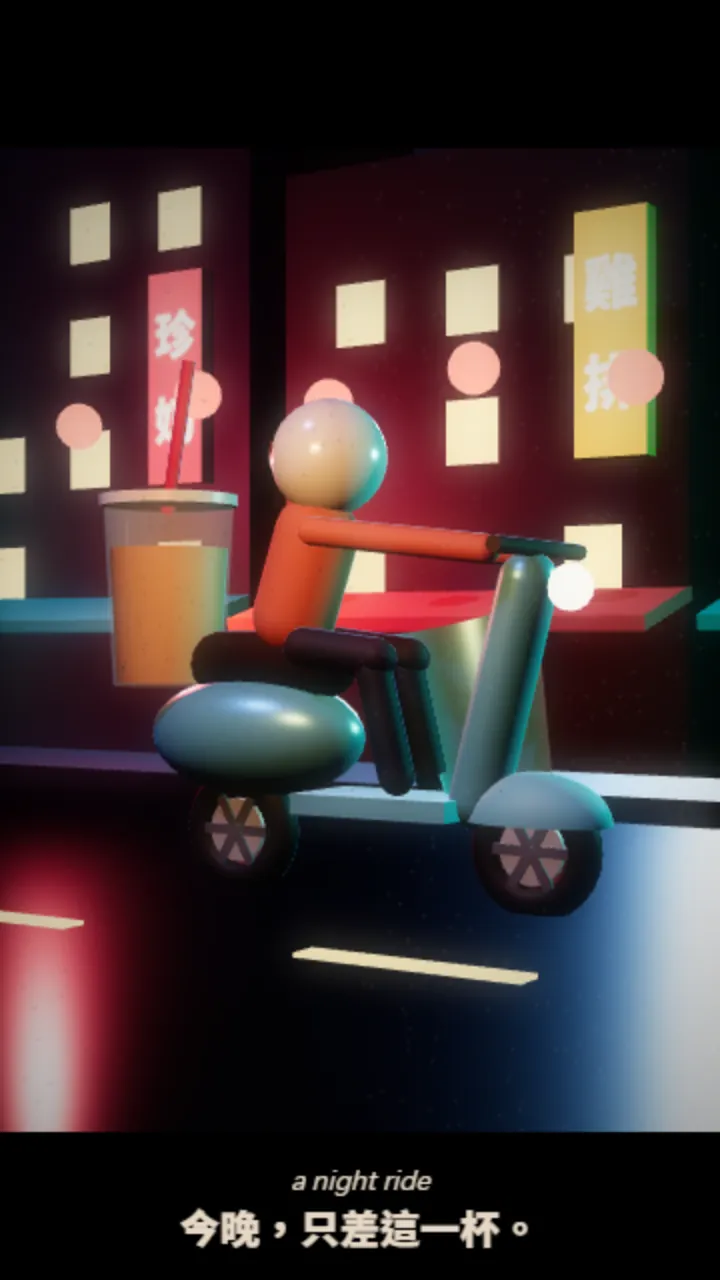
Style: cinematic 3D, using three.js. PBR materials, ACES tone mapping, soft shadows.
The signs are real light sources (warm, hot-pink and cyan point lights on the road), the headlight is a spotlight pointing forward, and the road is slightly reflective.
Low camera that slowly orbits and pushes in on the scooter. Post: fake bloom (blur, then screen it back on top), vignette, film grain,
letterbox bars, and an end title "[a night ride / tonight, just this one cup.]"
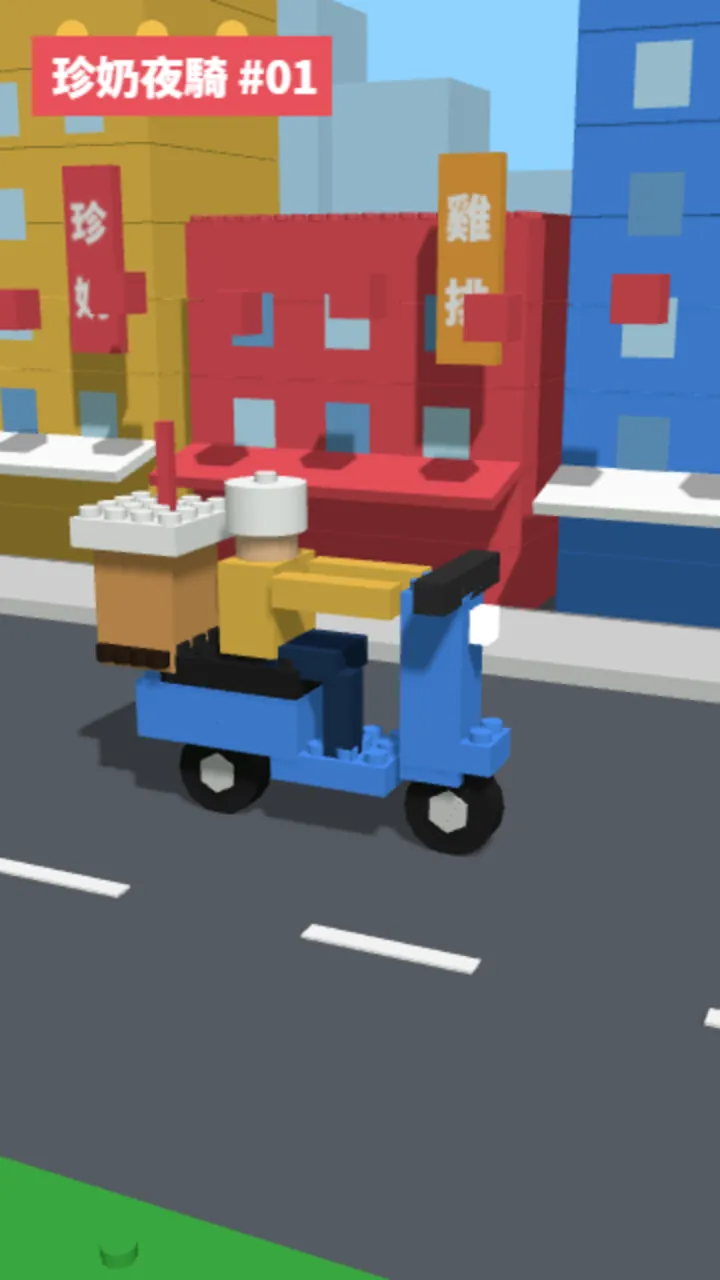
Style: toy bricks, using three.js. Build everything from bricks on a 0.2-unit grid, with studs on top,
glossy plastic, bright primary colours. Daytime, blue sky, brick clouds, a green baseplate, clear shadows.
The scooter, the rider and the [bubble-tea cup] are bricks too. A red brick label top left: "[Night Ride #01]".
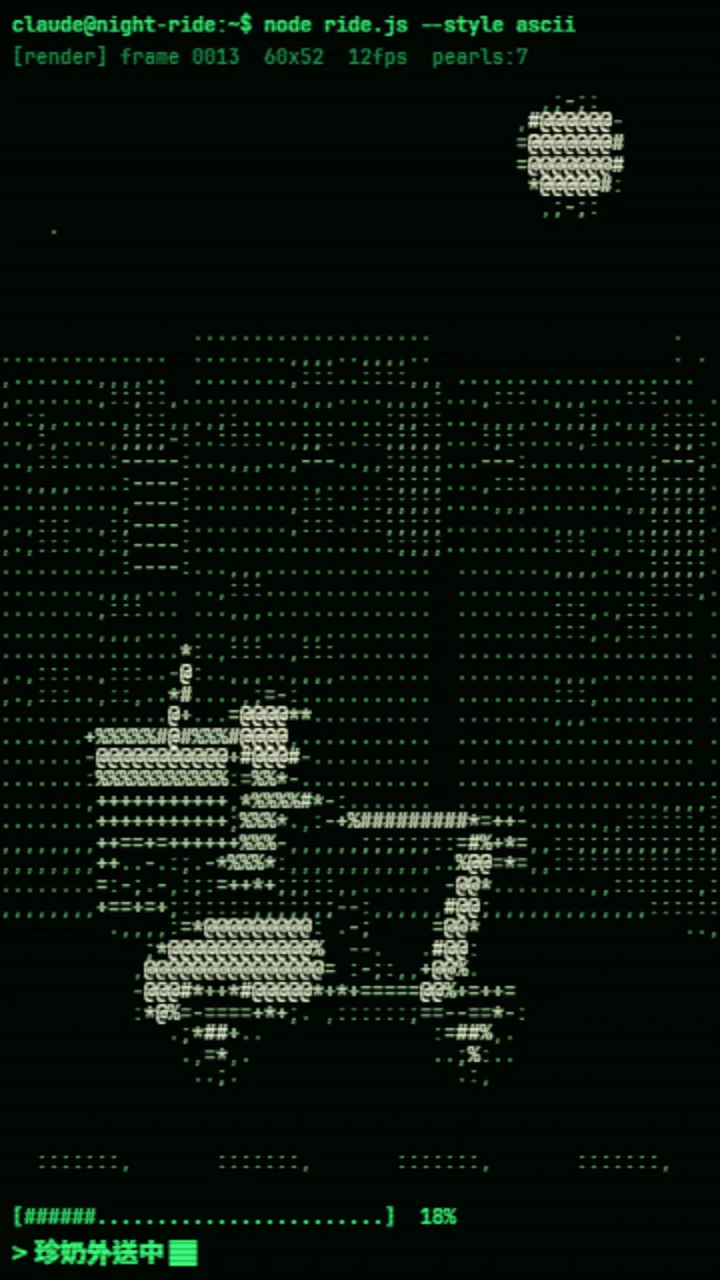
Style: ASCII terminal. First draw the scene into a 60 x 52 grid, then pick one character per cell by brightness from " .,:;-=+*%#@",
phosphor green on black, 12 fps. A fake command line at the top "claude@[night-ride]:~$ node [ride].js --style ascii" with a frame counter,
and at the bottom a [#####.....] progress bar and "> [bubble tea on its way]" with a blinking cursor. Scanlines on top.
05Tips: new hero, record a video
- For a new topic (a cat on a bicycle, a coffee cup), change only the scene prompt; in the 10 style prompts, change only the [ ] words.
- One style per chat. If you put them all in one chat, the previous style tends to leak into the next.
- To tweak details, just say "thicker lines" or "make the signs blue"; no need to paste everything again.
- To record a video, ask Claude to screenshot it frame by frame with headless Chrome (e.g. Puppeteer) using seek(t), then join the frames into an MP4 with ffmpeg.
06Good to know
- The 10 style names are our own, not built-in Claude modes.
- The same prompt gives slightly different results each run; that is normal. If you don't like something, ask it to change it.
- For the 3 three.js styles, if the file loads three.js from the internet (a CDN), you need to be online when you open it.
- Chinese text on screen uses your computer's fonts, so it can look different on another machine; to lock it, ask Claude to use a commercial-use font such as Noto Sans TC.
- The "bubble-tea night ride" is a fictional demo scene; the shop names and signs are not real shops.