Travel photo to hand-drawn poster: photo on top, illustration below, one prompt (Claude writes, ChatGPT draws)
Attach a travel photo, paste one prompt, and ChatGPT draws a 3:4 split poster with a hand-lettered title and a poem line. Full prompt and 7 Taiwan tests.
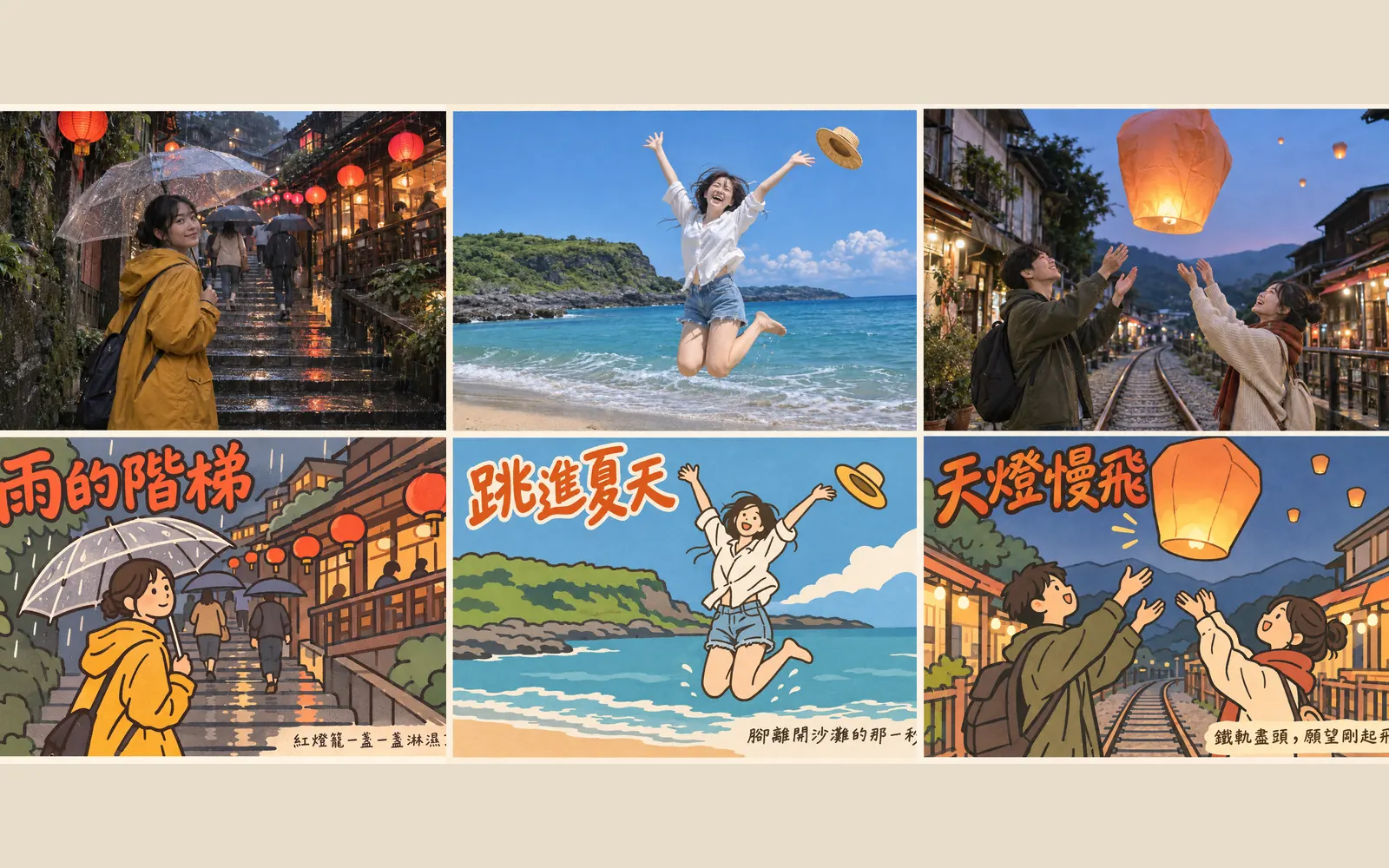
Turn a travel photo into a hand-drawn travel poster: the photo on top, the same moment as a flat illustration below, plus a wobbly hand-lettered title and one line of poetry. It is not a filter. It is one prompt. This guide shows how we made seven Taiwan posters: Claude wrote the prompt and every poem line, ChatGPT drew the images, and the full prompt is below. To be clear: we had no real travel photos, so ChatGPT generated the demo photos too. The people in the photos are AI-generated, not real people.
01The result first: photo on top, illustration below, one moment
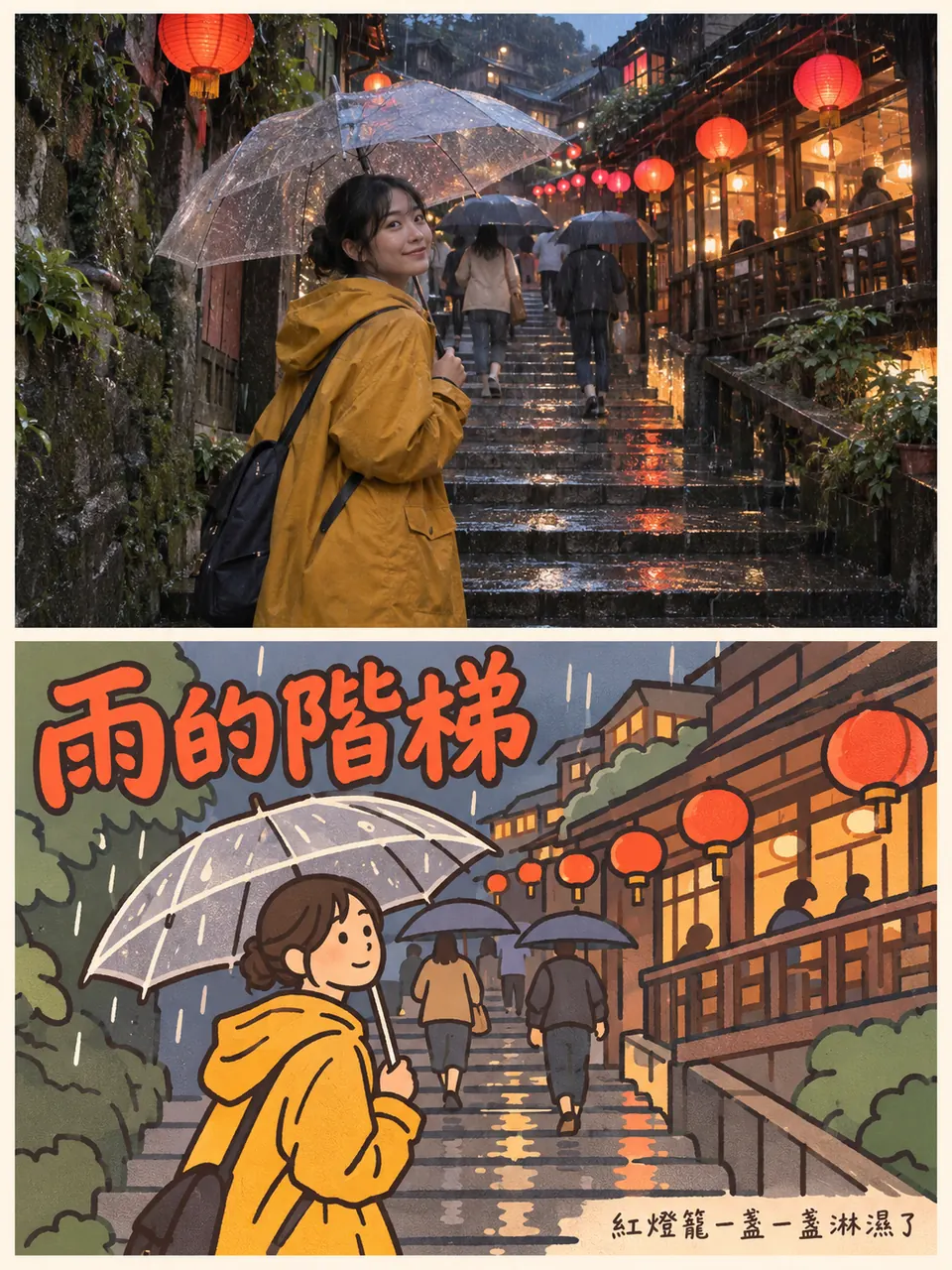
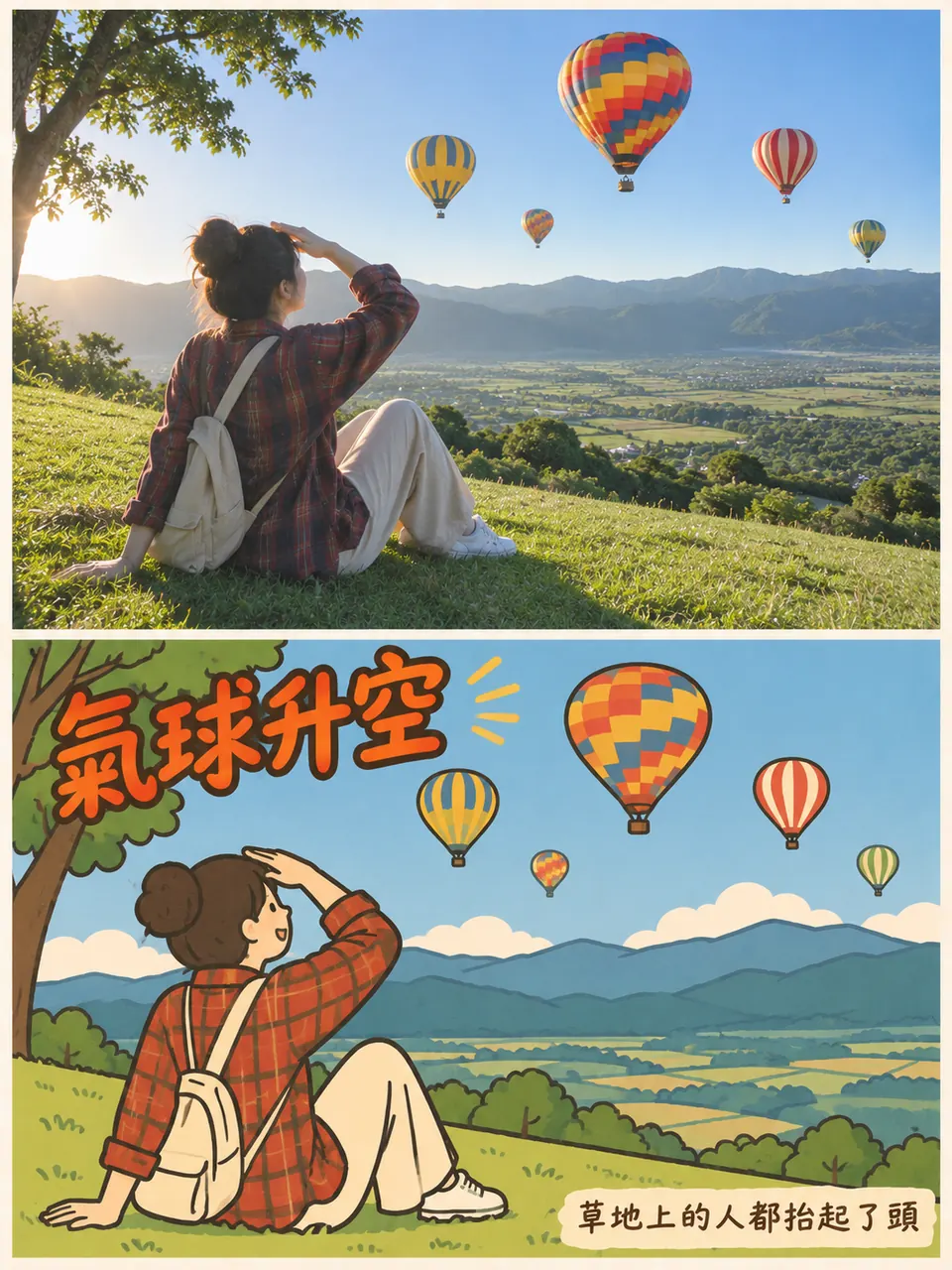
The poster works for a simple reason: the photo and the drawing mirror each other, so your eye flips between them. The most important part of the prompt is not "make it cute". It is "the lower half must match the photo". Every poster has four fixed parts:
- Top half: the travel photo, kept as a photograph, with no text on it.
- Bottom half: the same moment redrawn as a Korean-style flat illustration. Big colour blocks, thick outlines, dot eyes. Cute, not childish.
- Hand-lettered title: 2 to 4 characters in the upper left of the illustration, each one tilted and a different size, like marker handwriting.
- One poem line: 12 characters or fewer, small, in the bottom-right corner.
02Step 1: ask Claude for the title and the poem line
The poem line is the soul of the poster, and it is easy to write a cliché. Open Claude (claude.ai), attach your photo or describe it, and paste this:
Write a hand-lettered title of 2 to 4 Chinese characters for this travel photo, and one poem line of 12 characters or fewer. Give me an image, not a motivational quote. Traditional Chinese. The place is [place], and I am [doing what].
We gave Claude seven Taiwan travel moments in one go and asked for the prompt template plus seven title and poem pairs. These seven are its answer, unedited (English glosses are ours):
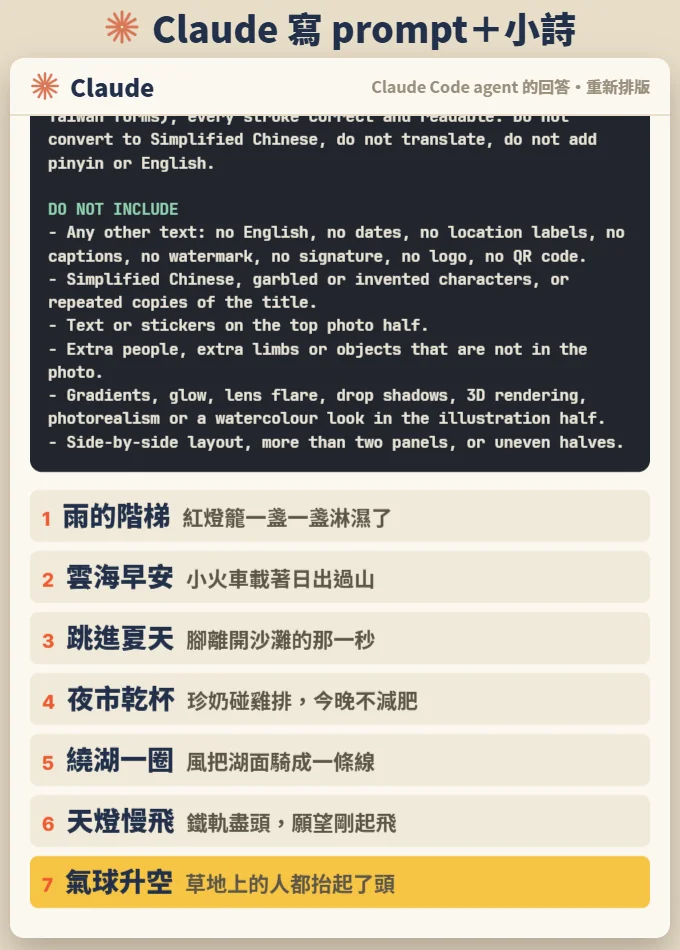
- 雨的階梯|紅燈籠一盞一盞淋濕了 (Jiufen: "Stairs of Rain / the red lanterns get wet one by one")
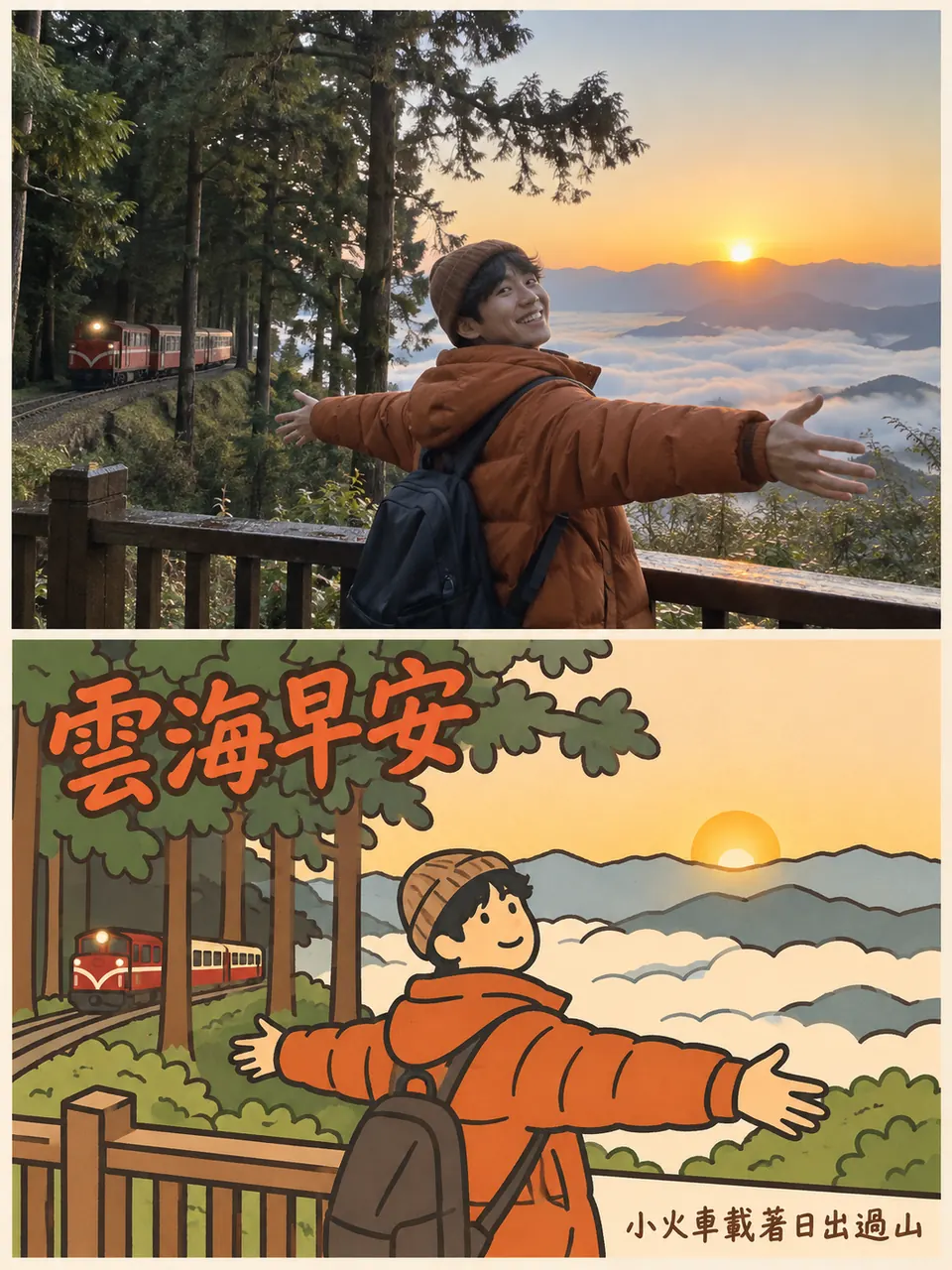
- 雲海早安|小火車載著日出過山 (Alishan: "Good Morning, Sea of Clouds / the little train carries the sunrise over the mountain")
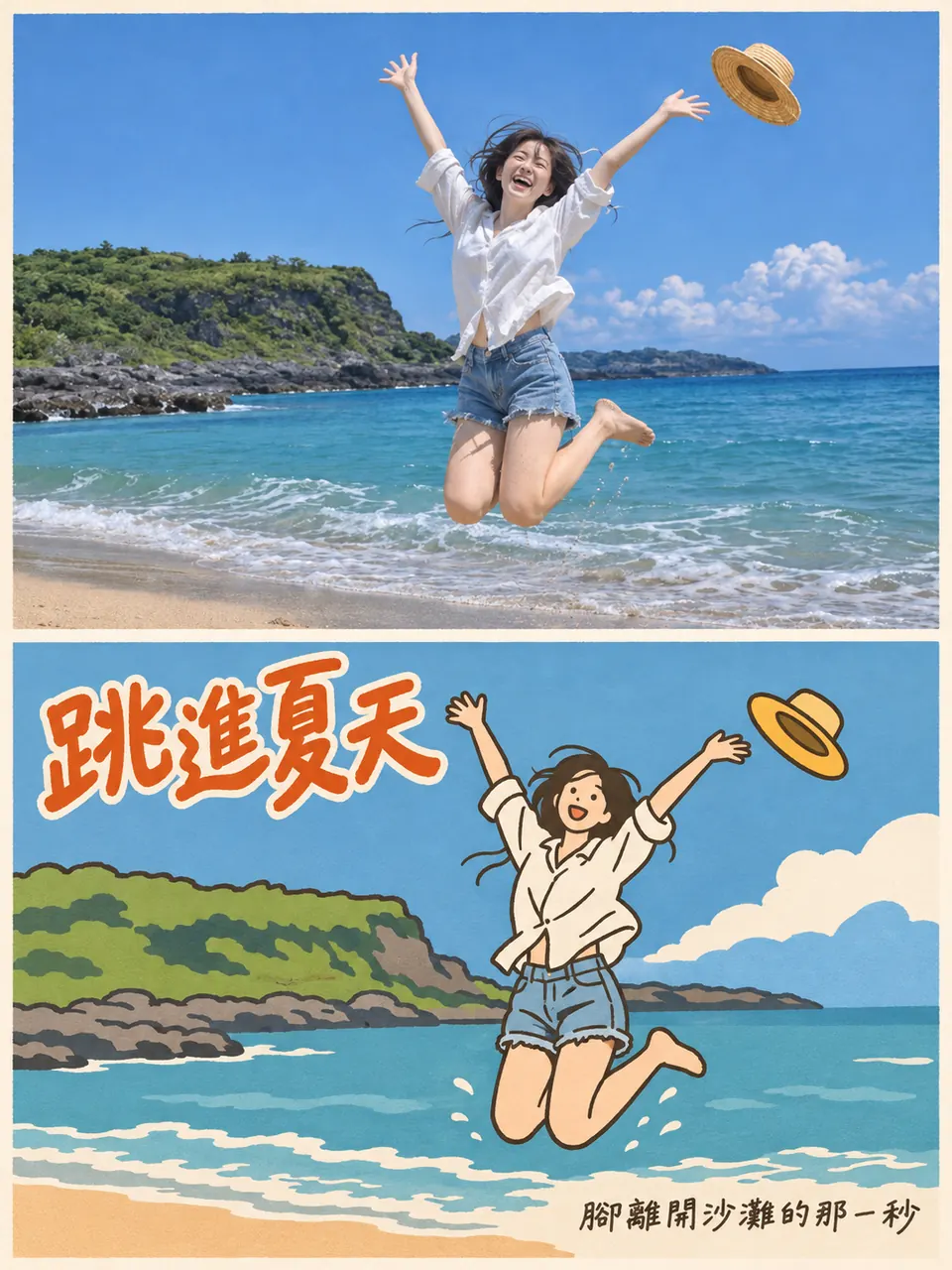
- 跳進夏天|腳離開沙灘的那一秒 (Kenting: "Jump into Summer / the second my feet left the sand")
- 夜市乾杯|珍奶碰雞排,今晚不減肥 (night market: "Night Market Cheers / bubble tea meets fried chicken, no diet tonight")
- 繞湖一圈|風把湖面騎成一條線 (Sun Moon Lake: "Once Around the Lake / the wind rides the lake into a line")
- 天燈慢飛|鐵軌盡頭,願望剛起飛 (Pingxi: "Lantern, Fly Slowly / at the end of the track, a wish takes off")
- 氣球升空|草地上的人都抬起了頭 (Luye Highland, Taitung: "Balloons Rising / everyone on the grass looked up")
03Step 2: attach your photo and paste this prompt
Open ChatGPT (chatgpt.com), start a new chat, attach your travel photo, then paste the whole prompt below. Change only two things: the title and the poem line from step 1. Claude wrote this prompt and we did not change a word. It asks for Traditional Chinese lettering; for another language, edit the TEXT section.
Create ONE vertical travel poster, aspect ratio 3:4 (portrait), using the photo I attached.

LAYOUT
- The poster is split into two equal halves, stacked top and bottom, separated by a thin off-white horizontal gap. The whole poster has a narrow off-white border, like a printed card.
- TOP HALF: my attached photo, kept as a real photograph. Do not redraw, restyle, filter or beautify it. Crop it to fit the top half and keep the main people and the landmark in frame. No text on the photo.
- BOTTOM HALF: the same moment redrawn as an illustration. Same composition, same camera angle, same number of people, same poses, same clothing colours, same key objects and scenery as the photo, so the two halves clearly mirror each other.

ILLUSTRATION STYLE (bottom half only)
- Korean-style flat illustration: big simple colour blocks, thick slightly uneven dark outlines of a consistent weight, rounded simplified shapes.
- Completely flat colour. No gradients, no realistic shading, no 3D, no photo texture. A faint paper grain is fine.
- Cute but not childish: simple faces with dot eyes and a small mouth, natural adult body proportions, calm expressions. Not chibi, no oversized heads, no sparkly anime eyes, no blush stickers.
- Simplify the background into 3 to 5 large shapes. Keep only the details that make the place recognisable.

COLOUR
- Limited palette of 5 to 6 colours, sampled from the photo's own main colours and then made slightly softer and warmer. Add one bright accent colour, used on the most important object and on the title.
- Off-white paper tone (#F7F2E8) for the border, the gap and any empty space. No pure black; use deep navy or dark brown for outlines.

TEXT (Traditional Chinese only, exactly as written, nothing added)
- Title: "[your title]"
  Hand-lettered with a thick marker brush, large, placed in the upper-left area of the illustration. The characters are wobbly and uneven: each one tilted a few degrees in a different direction, slightly different in size, baseline not straight. It must look drawn by hand, not like a font. Accent colour or off-white, whichever reads best, with a dark outline.
- Small poem: "[your poem line]"
  One single line, small, thin handwritten pen lettering, placed in the bottom-right corner of the illustration with a comfortable margin. Dark outline colour, quiet and understated.
- Both texts must be Traditional Chinese characters (繁體中文, Taiwan forms), every stroke correct and readable. Do not convert to Simplified Chinese, do not translate, do not add pinyin or English.

DO NOT INCLUDE
- Any other text: no English, no dates, no location labels, no captions, no watermark, no signature, no logo, no QR code.
- Simplified Chinese, garbled or invented characters, or repeated copies of the title.
- Text or stickers on the top photo half.
- Extra people, extra limbs or objects that are not in the photo.
- Gradients, glow, lens flare, drop shadows, 3D rendering, photorealism or a watercolour look in the illustration half.
- Side-by-side layout, more than two panels, or uneven halves.
- LAYOUT: locks the layout. Two equal halves, a thin off-white gap between them and a narrow off-white border, like a printed card.
- "Same composition, same camera angle, same number of people, same poses…": this makes the drawing mirror the photo. It is the most important line.
- ILLUSTRATION STYLE: completely flat colour, no gradients, shading or 3D. "Not chibi" stops big-head cartoon characters.
- COLOUR: 5 to 6 colours sampled from the photo, plus one bright accent for the key object and the title.
- TEXT: Traditional Chinese only, exactly as written, nothing added, and where the title and the poem line go.
- DO NOT INCLUDE: no English, dates, location labels, watermarks, Simplified Chinese or extra people.
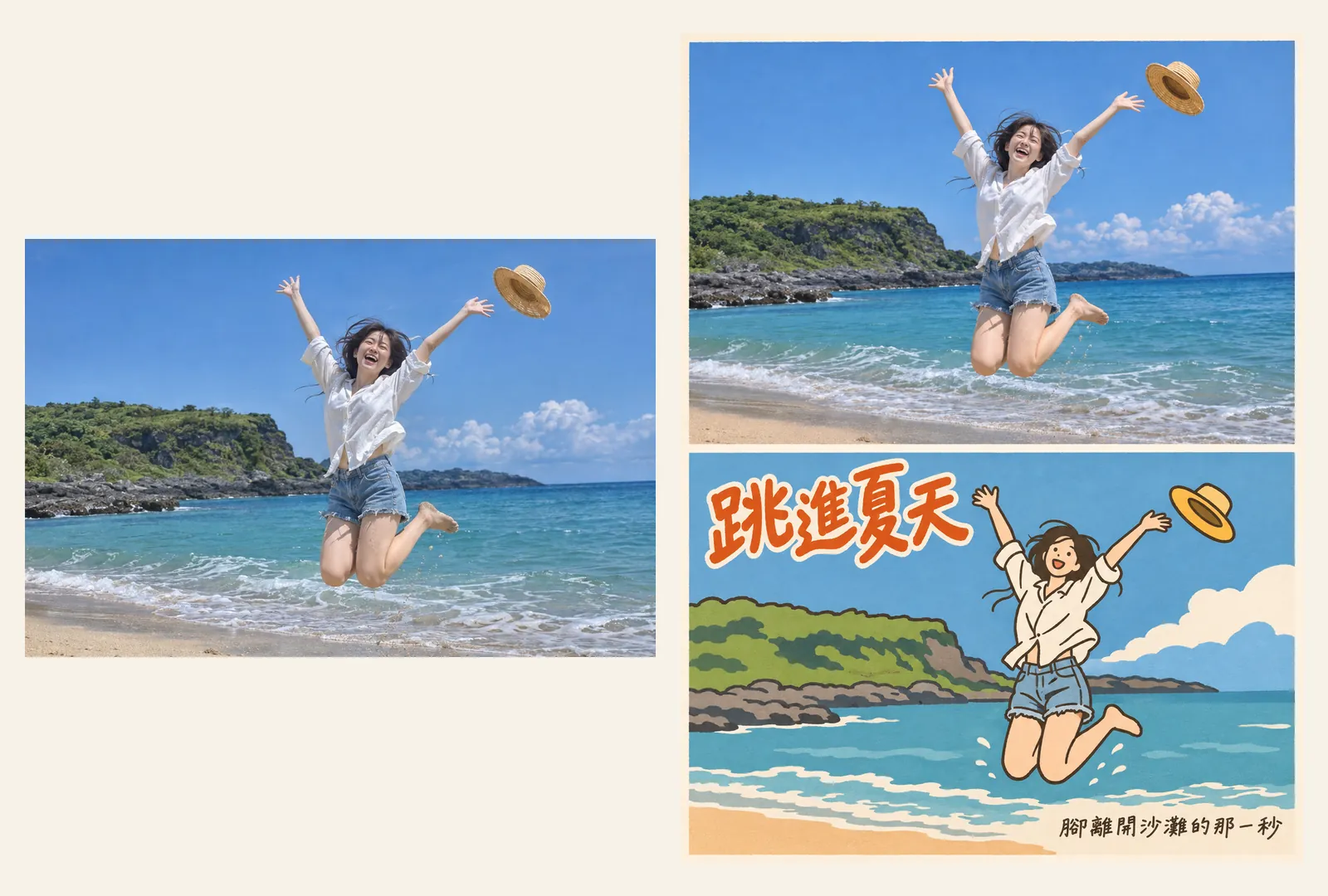
We made this Kenting poster the way you would: one photo attached, Claude's prompt pasted, only the two blanks filled, nothing else said. ChatGPT asked no questions and drew it on the first try.
04Step 3: stay in the same chat for the whole trip
From the second poster on you do not need the full prompt. Attach the next photo in the same chat and paste these three lines. ChatGPT keeps the earlier rules, so the outlines, palette and lettering stay consistent across the set.
Same brief and the same rules, new poster.
Title: "[your title]"
Small poem: "[your poem line]"
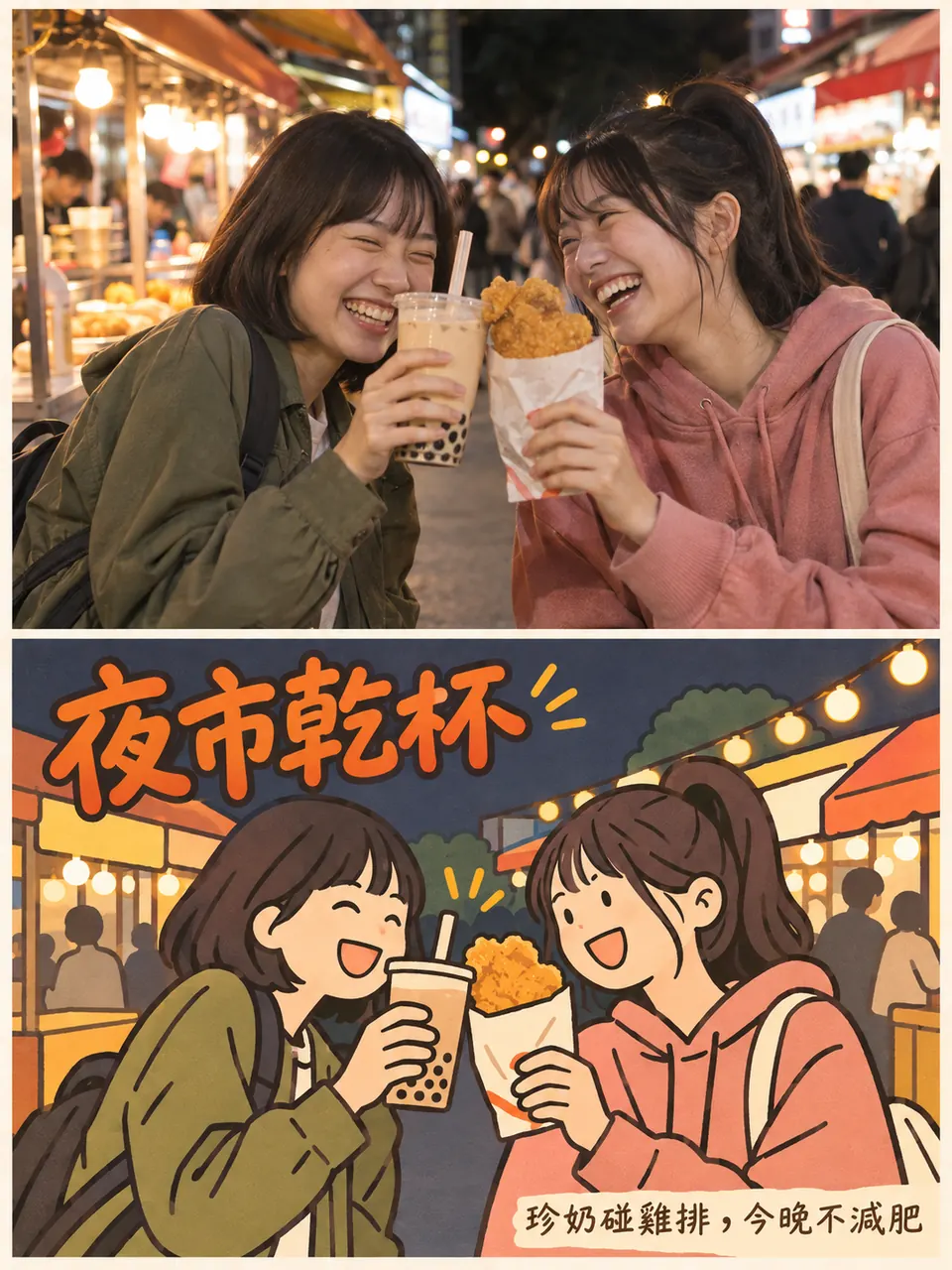
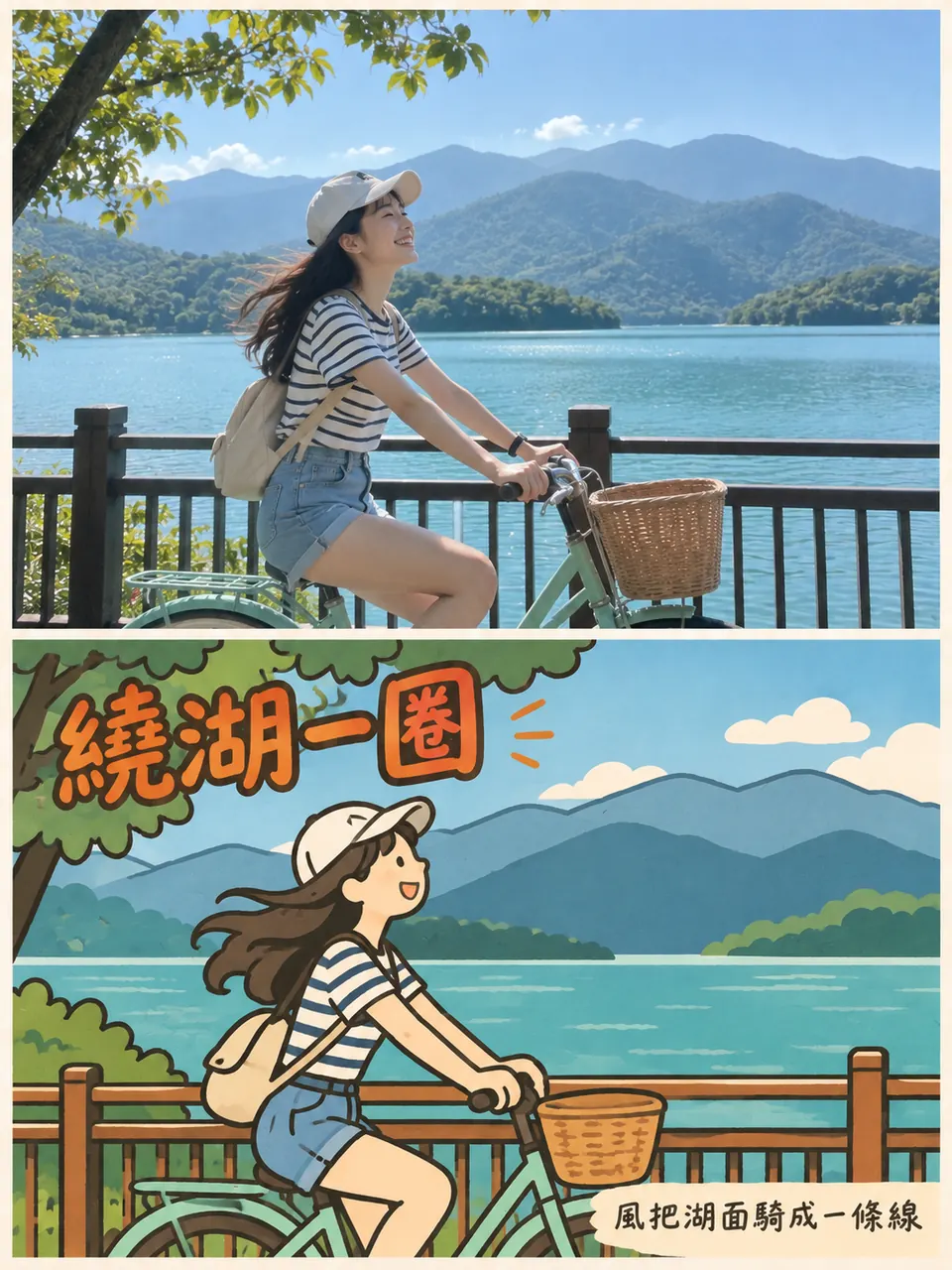
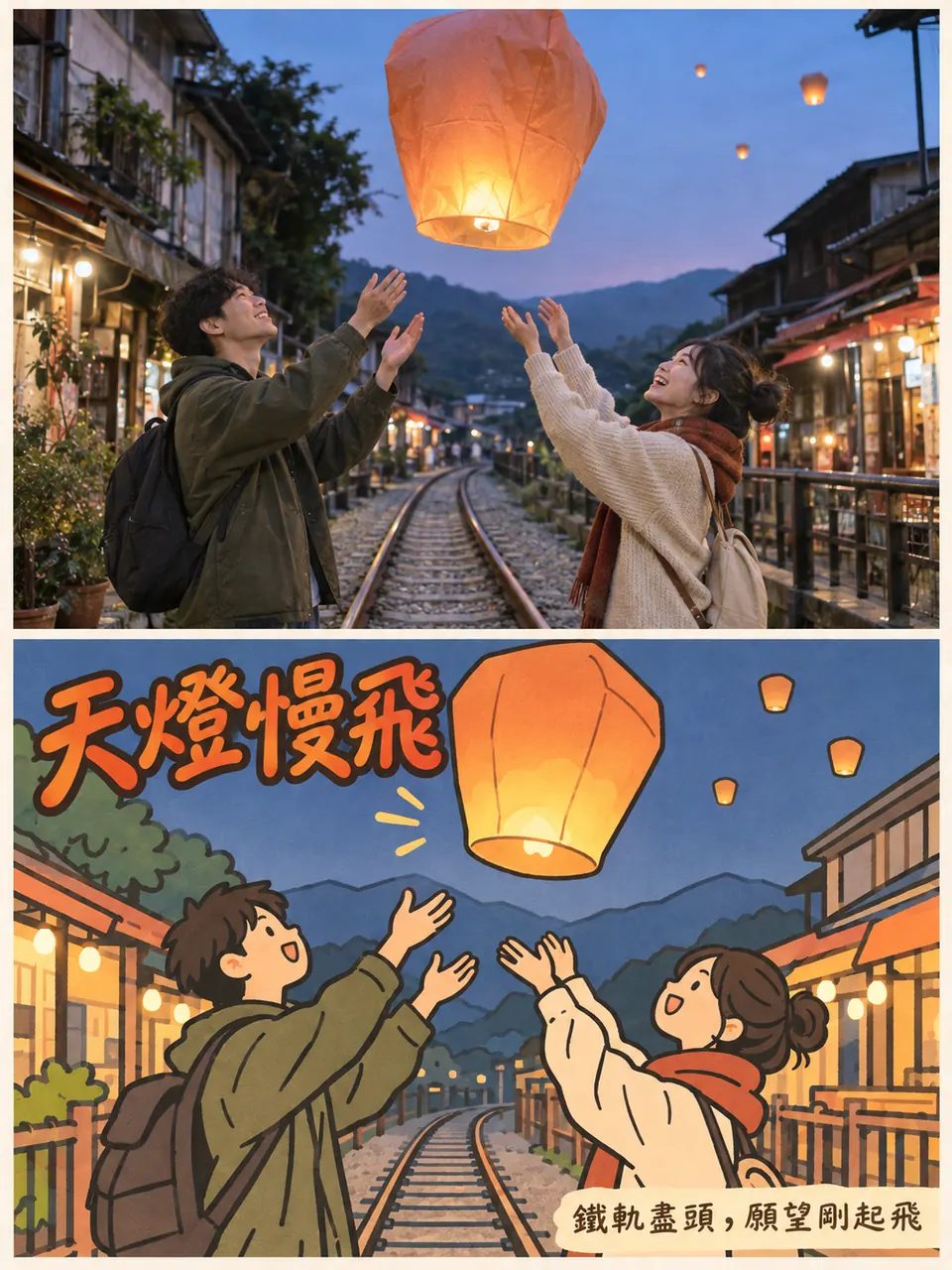
To be honest: our seven posters were made back to back in one chat, but that run had no attached photos (see the next section). We ran the attach-a-photo method in full only once, for Kenting. So "attach photos and build a whole set" is our recommendation by the same logic, not something we did seven times.
05No photo? That is how we made our demo
Yes, it works. We had no real travel photos, so we asked ChatGPT to generate the top photo as well. For the first poster, Jiufen, we put a paragraph in front of Claude's prompt describing an imagined photo. ChatGPT did not draw straight away. It asked whether we would upload a photo or confirm that both halves should be generated from scratch. We confirmed, and it drew the first poster.
Posters 2 to 7 followed in the same chat. Each message was the text below, with only the scene, title and poem line changed:
Same brief and the same rules as above, new poster. Again generate both halves from scratch in one 3:4 image: top half = a photorealistic candid phone travel photo (fictional people, no readable text in the photo), bottom half = the flat illustration of that same photo.

Photo scene: [describe the scene: place, time, who, what they wear, what they are doing]

Title: "[your title]"
Small poem: "[your poem line]"
06What if the lettering is wrong?
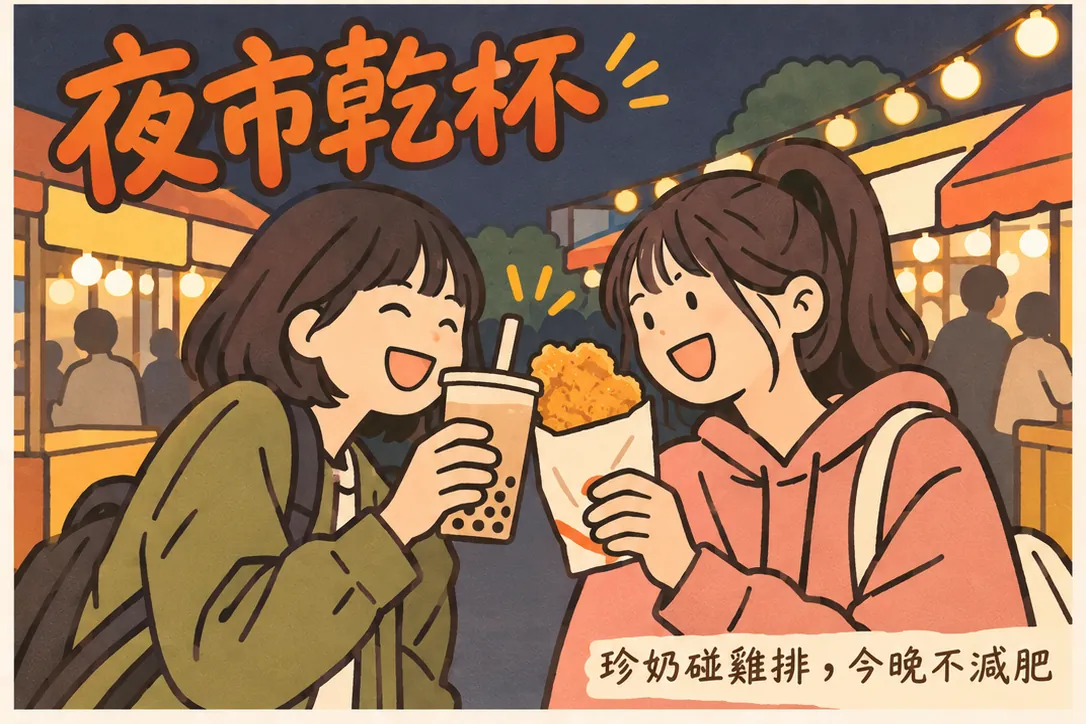
Chinese text is where AI images fail most. Our seven posters carry 14 lines of text. We checked each against Claude's wording, and all were right the first time, with no retries. Characters with many strokes, or rare ones, can still come out wrong or turn Simplified. You do not need to redo the poster. As Claude suggested, reply with one line:
Fix the text only and change nothing else. The title is "[your title]" and the poem line is "[your poem line]", both in Traditional Chinese.
- Zoom all the way in and check character by character: missing strokes, or Simplified forms (for example 燈 turning into 灯, 鐵 into 铁).
- Check that no text or stickers were added to the top photo.
- Check that the number of people, the poses and the clothing colours in the drawing match the photo.
- Check the faces. The prompt bans blush stickers and big-head characters, but AI does not always obey, so zoom in once.
07Good to know
- The people in the photos are AI-generated, not real people. We had no real travel photos, so ChatGPT generated both the top photos and the illustrations in all seven demos. The photo we attached for Kenting was itself AI-generated.
- The prompt says "do not redraw or beautify the photo", but ChatGPT redraws the whole image. On our Kenting poster the top photo was slightly re-rendered: same pose, framing and colours, not the original pixels. Faces and small details may differ a little from your photo. If that matters, paste your original over the top half yourself.
- If friends or family are in the photo, ask them before you upload it.
- We made this set in our own ChatGPT on 10 November 2026; Claude wrote the prompt, titles and poem lines. AI results differ every time, and ChatGPT's interface, limits and features follow OpenAI's current help pages.
- The "colouring in" of the lower half in the reel is our animation, not a recording of ChatGPT drawing.
- The split layout is inspired by the travel photo split posters popular on Instagram. Our posters, titles and poem lines are our own.